Advertisements
Advertisements
Question
Answer the following question.
Why is prism binoculars preferred over traditional binoculars? Describe its working in brief.
Advertisements
Solution
- Traditional binoculars use only two cylinders. Distance between the two cylinders can’t be greater than that between the two eyes. This creates a limitation of the field of view.
- A prism binocular has two right-angled glass prisms that apply the principle of total internal reflection.
- The incident light rays are reflected internally twice giving the viewer a wider field of view. For this reason, prism binoculars are preferred over traditional binoculars.
Working:

Prism binoculars
- The prism binoculars consist of 4 isosceles, right-angled prisms of a material having a critical angle less than 45°.
- The prism binoculars have a wider input range compared to traditional binoculars.
- The light rays incident on the prism binoculars, first get total internally reflected by the isosceles, right-angled prisms 1 and 4.
- These reflected rays undergo another total internal reflection by prisms 2 and 3 to form the final image.
APPEARS IN
RELATED QUESTIONS
What is total internal reflection?
Total internal reflection occurs only when a ray of light passes from a ______ medium to a ______ medium.
Write the relation between the refractive index and critical angle for a given pair of optical media?
Solve the previous problem if the paperweight is inverted at its place so that the spherical surface touches the paper.
Plot a graph between
Angle of incidence versus angle of refraction.
In the following figure, show two rays A and B travelling from water to air. If the critical angle for water- air surface is 48°, complete the ray diagram showing the refracted rays for each. State conditions when the ray will suffer total internal reflection.
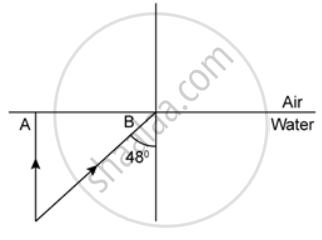
Write down the relationship between the critical angle and the refractive index of the medium.
Images formed by totally reflecting prisms are brighter than the image formed by ordinary reflected light, why?
A ray of light incident at an angle of incidence ‘i’ passes through an equilateral glass prism such that the refracted ray inside the prism is parallel to its base and emerges from the prism at an angle of emergence ‘e’.
What can you say about the value of the angle of deviation in such a situation?
State one factor on which a critical angle for a given pair of media depends. The critical angle for the glass-air interface is 45° for the yellow light. Will it be equal to, less than or greater than 45° for (i) red light, (ii) blue light?
Observe the given figure and write appropriate phenomenon of light in the box.
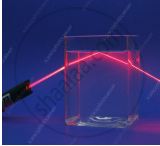
The angle of minimum deviation produced by a thin glass prism in air is 'δ'. If that prism is immersed in water, the angle of minimum deviation will be ______.
( aμg = refractive index of glass w.r.t, air aμw = refractive index of water w.r.t. air)
A particle is projected such that the horizontal range and vertical height are equal. Then the angle of projection is :
A bundle of glass threads, each of which is capable of transmitting messages using light waves is called ______.
The critical angle is defined as the angle of incidence at which the total internal reflection starts to occur.
What is a mirage? How does it occur?
A jar of height h is filled with a transparent liquid of refractive index µ (Figure). At the centre of the jar on the bottom surface is a dot. Find the minimum diameter of a disc, such that when placed on the top surface symmetrically about the centre, the dot is invisible.
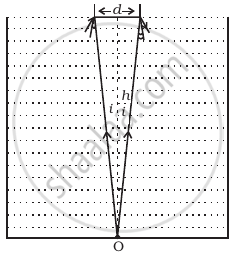
State the condition under which total internal reflection occurs. Give the mathematical expression for total internal reflection.
A light is entering from one medium refractive index `("RI" =5/3)` to another medium at an angle 30°. The angle of refraction for other medium is sin-1 `(5/6)`. then the increase in angle of incidence is ______ such that the ray of light reflected back into the same medium.
Find the value of θ in the given figure.
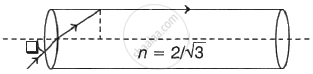
- Assertion (A): Propagation of light through an optical fibre is due to total internal reflection taking place at the core-cladding interface.
- Reason (R): Refractive index of the material of the cladding of the optical fibre is greater than that of the core.
Total internal reflection is defined as the complete reflection of light back into an optically denser medium when:
When the angle of incidence for light travelling from a denser medium to a rarer medium is greater than the critical angle, the result is:
As the angle of incidence increases for light going from a denser medium to a rarer medium, the angle of refraction:
