Advertisements
Advertisements
Question
A ray of light passes through a prism of refractive index `sqrt2` as shown in the figure. Find:
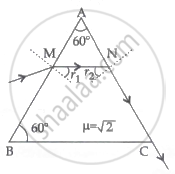
- The angle of incidence (∠r2) at face AC.
- The angle of minimum deviation for this prism.
Advertisements
Solution
(i) Since at point N, the angle of refraction is 90°, then ∠r2 is the critical angle for the glass-air pair of media.
sin ∠r2 = `1/μ = 1/sqrt2`
∴ ∠r2 = `sin^-1(1/sqrt2)` = 45°
(ii) μ = `sin(("A" + δ_"m")/2)/(sin "A"/2)`
Or, `sqrt2 = sin ((60^circ + δ_"m")/2)/(sin 60^circ/2)`
Or, `sqrt2 = sin (30^circ + δ_"m"/2)/(1/2)`
Or, 0.7 = `sin(30^circ + δ_"m"/2)`
Or, sin−1 0.7 = `30^circ + δ_"m"/2`
Or, 44.4° = `30^circ + δ_"m"/2`
∴ δm = 28.8°
APPEARS IN
RELATED QUESTIONS
Draw diagram to illustrate the total internal reflection.
Prove the statement.
A rainbow is the combined effect of the refraction, dispersion, and total internal reflection of light.
The diagram below shows a light source P embedded in a rectangular glass block ABCD of critical angle 42°. Complete the path of the ray PQ till it emerges out of the block. [Write necessary angles].

How does a ray of light bend when it travels from denser to rarer medium.
Images formed by totally reflecting prisms are brighter than the image formed by ordinary reflected light, why?
A ray of light is incident on a glass surface at an angle of 50° with the corresponding angle of refraction 30°. Find the value of the R.I. of glass.
Choose the correct option.
Angles of deviation for extreme colours are given for different prisms. Select the one having maximum dispersive power of its material.
The twinkling effect of star light is due to ______.
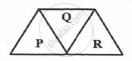
A given ray of light suffers minimum deviation in an equilateral prism P. Additional prism Q and R of identical shape and of the same material as P are now added as shown in the figure. The ray will now suffer ______.
Name any two phenomena which take place in the formation of a rainbow.
