Advertisements
Advertisements
Question
The phenomena involved in the reflection of radiowaves by ionosphere is similar to ______.
Options
reflection of light by a plane mirror.
total internal reflection of light in air during a mirage.
dispersion of light by water molecules during the formation of a rainbow.
scattering of light by the particles of air.
Advertisements
Solution
The phenomena involved in the reflection of radiowaves by ionosphere is similar to total internal reflection of light in air during a mirage.
Explanation:
Radio waves are reflected by a layer of the atmosphere called the Ionosphere, so they can reach distant parts of the Earth. The reflection of radio waves by ionosphere is due to total internal reflection. It is the same as total internal reflection of light in the air during a mirage, i.e., angle of incidence is greater than critical angle.
Important point: The ionized part of the Earth’s atmosphere is known as the ionosphere. Ultraviolet light from the sun collides with atoms in this region knocking electrons loose. The creates ions or atoms with missing electrons. This is what gives the Ionosphere its name- and it is the free electrons that cause the reflection and absorption of ratio waves.

APPEARS IN
RELATED QUESTIONS
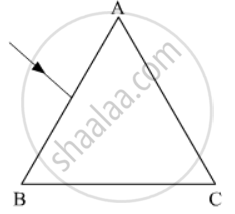
The figure shows a ray of light falling normally on the face AB of an equilateral glass prism having refractive index`3/2`, placed in water of refractive index `4/3`.Will this ray suffer total internal reflection on striking the face AC? Justify your answer.
What is total internal reflection?
The observation made by Swarali while doing the experiment is given below. Based on these write answers to the questions:
Swarali found that the light ray travelling from the denser medium to rarer medium goes away from the normal. If the angle of incidence (i) is raised by Swarali, the angle of refraction (r) went on increasing. However, after certain value of the angle of incidence the light ray is seen to return back into the denser medium.
Questions:
- What is the specific value of∠i called?
- What is the process of reflection of incident rays into denser medium called?
- Draw the diagrams of three observations made by Swarali.
Images formed by totally reflecting prisms are brighter than the image formed by ordinary reflected light, why?
The diagram shows a point source P inside a water container. Three rays A, B, and C starting from P are shown up to the water surface. Show in the diagram the path of these rays after striking the water surface. The critical angle for the water-air pair is 48°.

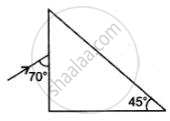
Complete the following diagram to show the path of the ray of a single colour in the diagram as if enters in and emerges out of the prism. Mark the angles wherever necessary. (Critical angle for glass = 42°).

Complete the following diagram to show the path of the ray of a single colour in the diagram as if enters in and emerges out of the prism. Mark the angles wherever necessary. (Critical angle for glass = 42°).
Answer the following question.
Under what conditions are total internal reflection possible? Explain it with a suitable example.
Describe the construction and working of an optical fibre.
The resultant `vec"R"` of `vec"P"` and `vec"Q"` is perpendicular to `vec"P"`. Also `|vec"P"|=|vec"R"|`. The angle between `vec"P"` and `vec"Q"` is ______.
[tan 45° = 1]
For a ray of light, the critical angle is minimum when it travels from ______.
What is a mirage? How does it occur?
A ray of light incident at an angle θ on a refracting face of a prism emerges from the other face normally. If the angle of the prism is 5° and the prism is made of a material of refractive index 1.5, the angle of incidence is ______.
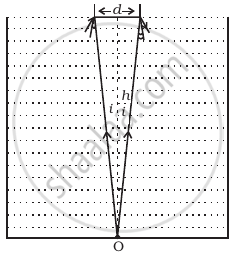
A jar of height h is filled with a transparent liquid of refractive index µ (Figure). At the centre of the jar on the bottom surface is a dot. Find the minimum diameter of a disc, such that when placed on the top surface symmetrically about the centre, the dot is invisible.
State the condition under which total internal reflection occurs. Give the mathematical expression for total internal reflection.
Observe the given figure of the raindrop and answer the following questions:
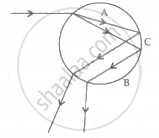
- Label A and B of the given diagram. Why colour will deviate most.
- Name the phenomenon shown in label C.
Find the value of θ in the given figure.
The critical angle for water, which has a refractive index of 1.33, is:
The formation of a mirage is explained using:
