Advertisements
Advertisements
Question
What do you understand by the deviation produced by a prism? Why is it caused?
Advertisements
Solution
Prism-produced Deviation is the bending of a light beam away from its intended path. Ray AB would have followed the path if there had been no prism. ABDF, but the prism has forced the light ray to bend twice in the direction of the prism's base, and the emerging beam EK seems to be coming from DEK.
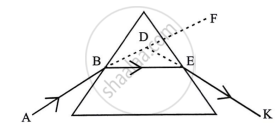
Cause: When light travels from one medium to another, in this example, from air to a glass prism, its speed changes. This change in speed causes the light to deflect and enter the new medium glass at a different angle.
APPEARS IN
RELATED QUESTIONS
Draw the diagram of a right-angled isosceles prism which is used to make an invented image erect.
A light ray does not bend at the boundary in passing from one medium to the other medium if the angle of incident is ______.
Total internal reflection occurs only when a ray of light passes from a ______ medium to a ______ medium.
Total internal reflection can take place only if ______.
How does a ray of light bend when it travels from rarer to denser medium
Answer the following question.
What are the advantages of optical fibre communication over electronic communication?
The twinkling effect of star light is due to ______.
A ray of light incident at an angle θ on a refracting face of a prism emerges from the other face normally. If the angle of the prism is 5° and the prism is made of a material of refractive index 1.5, the angle of incidence is ______.
Small air bubbles rising up a fish tank appear silvery when viewed from some particular angle is due to the ______.
