Advertisements
Advertisements
प्रश्न
What do you understand by the deviation produced by a prism? Why is it caused?
Advertisements
उत्तर
Prism-produced Deviation is the bending of a light beam away from its intended path. Ray AB would have followed the path if there had been no prism. ABDF, but the prism has forced the light ray to bend twice in the direction of the prism's base, and the emerging beam EK seems to be coming from DEK.
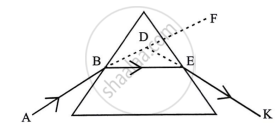
Cause: When light travels from one medium to another, in this example, from air to a glass prism, its speed changes. This change in speed causes the light to deflect and enter the new medium glass at a different angle.
APPEARS IN
संबंधित प्रश्न
A ray of light travels from water to air as shown in the diagram given below :
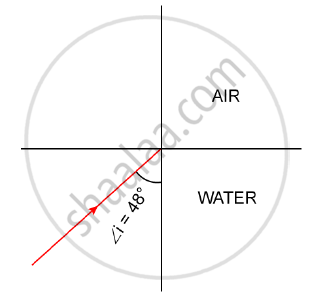
1) Copy the diagram and complete the path of the way. Given the critical angle for water is 48°.
2) State the condition so that internal reflection occurs in the above diagram.
A ray of light incident at an angle of incidence ‘i’ passes through an equilateral glass prism such that the refracted ray inside the prism is parallel to its base and emerges from the prism at an angle of emergence ‘e’.
How is the angle of emergence ‘e’ related to the angle of incidence ‘i’?
What is meant by the statement, ‘the critical angle for diamond is 24°’?
A ray of light is incident on a glass surface at an angle of 50° with the corresponding angle of refraction 30°. Find the value of the R.I. of glass.
Which of the following is not involved in formation of a rainbow?
Which one of the following is NOT the correct formula for refractive index of glass w.r.t. air (aμg) (i = angle of incidence, r = angle of refraction)
Which of the following statements about total internal reflection is true?
A green light is incident from the water to the air-water interface at the critical angle (θ). Select the correct statement.
The angle made by incident ray of light with normal of the reflecting surface is called ______.
The formation of a mirage is explained using:
