Advertisements
Advertisements
प्रश्न
A ray of light incident at an angle of incidence ‘i’ passes through an equilateral glass prism such that the refracted ray inside the prism is parallel to its base and emerges from the prism at an angle of emergence ‘e’.
How is the angle of emergence ‘e’ related to the angle of incidence ‘i’?
Advertisements
उत्तर
Angle of emergence = angle of incidence.
संबंधित प्रश्न
The diagram below shows a point source P inside a water container. Four rays A, B, C, D starting from the source P, are shown up to the water surface.
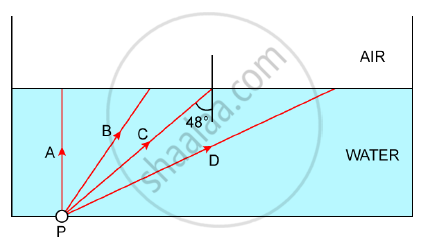
- Show in the diagram the path of these rays after striking the water surface. The Critical Angle for the water-air surface is 48°.
- Name the phenomenon which the rays B and D exhibit.
In the given figure PQ and PR are the two light rays emerging from an object P. The ray PQ is refracted as QS.

- State the special name given to the angle of incidence ∠PQN of the ray PQ.
- What is the angle of refraction for the refracted ray QS?
- Name the phenomenon that occurs if the angle of incidence ∠PQN is increased.
- The ray PR suffers partial reflection and refraction on the water-air surface. Give reason.
- Draw in the diagram the refracted ray for the incident ray PR and hence show the position of image of the object P by the letter P’ when seen vertically from above.
The diagram below shows a light source P embedded in a rectangular glass block ABCD of critical angle 42°. Complete the path of the ray PQ till it emerges out of the block. [Write necessary angles].

Why do diamonds sparkle?
What is meant by the statement, ‘the critical angle for diamond is 24°’?
Draw a diagram, properly labelled, to illustrate the use of a total reflecting prism (a right-angled isosceles prism) to turn a ray of light through 180°. Name an instrument in which this device is used.
Complete the following diagram to show the path of the ray of a single colour in the diagram as if enters in and emerges out of the prism. Mark the angles wherever necessary. (Critical angle for glass = 42°).

A Rainbow is a beautiful natural phenomenon formed because of the following:
Observe the given figure of the raindrop and answer the following questions:
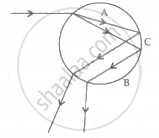
- Label A and B of the given diagram. Why colour will deviate most.
- Name the phenomenon shown in label C.
