Advertisements
Advertisements
प्रश्न
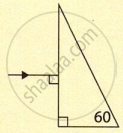
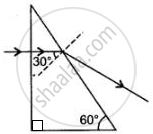
Complete the following diagram to show the path of the ray of a single colour in the diagram as if enters in and emerges out of the prism. Mark the angles wherever necessary. (Critical angle for glass = 42°).

Copy and complete the following diagram to show the path of the ray of monochromatic light as it enters and emerges from the prism. Mark the angle wherever necessary (critical angle is 42°).
Advertisements
उत्तर
APPEARS IN
संबंधित प्रश्न
A light ray does not bend at the boundary in passing from one medium to the other medium if the angle of incident is ______.
Write the necessary conditions for the phenomenon of total internal reflection to
occur ?
Plot a graph between
Sine of angle of incidence versus sine of angle of refraction,
Which of the following is not involved in formation of a rainbow?
Which one of the following is NOT the correct formula for refractive index of glass w.r.t. air (aμg) (i = angle of incidence, r = angle of refraction)
The twinkling effect of star light is due to ______.
A bundle of glass threads, each of which is capable of transmitting messages using light waves is called ______.
Write any two uses of total internal reflection.
- Assertion (A): Propagation of light through an optical fibre is due to total internal reflection taking place at the core-cladding interface.
- Reason (R): Refractive index of the material of the cladding of the optical fibre is greater than that of the core.
