Advertisements
Advertisements
प्रश्न
Advertisements
उत्तर
Factors affecting the critical angle are:
(i) The colour (or wavelength) of light.
(ii) The temperature (on changing the temperature of medium, its refractive index changes).
APPEARS IN
संबंधित प्रश्न
What do you understand by the deviation produced by a prism? Why is it caused?
State two conditions necessary for total internal reflection to occur.
The diagram below shows a light source P embedded in a rectangular glass block ABCD of critical angle 42°. Complete the path of the ray PQ till it emerges out of the block. [Write necessary angles].

Can light be ‘piped’ like sound in a doctor’s stethoscope?
If a ray of light passes from medium I to medium II without any change of direction, what can be said about the refractive indices of these media (angle I is not 0)?
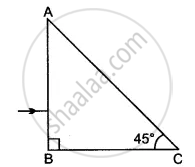
A ray of light passes through a right-angled prism as shown in the figure. State the angles of incidence at the faces AC and BC.
For a ray of light, the critical angle is minimum when it travels from ______.
The outer concentric shell in optic fiber is called ______.
The phenomena involved in the reflection of radiowaves by ionosphere is similar to ______.
A ray of light passes from vacuum into a medium of refractive index µ, the angle of incidence is found to be twice the angle of refraction. Then the angle of incidence is ______.
