Advertisements
Advertisements
प्रश्न
Which of the following is not involved in formation of a rainbow?
विकल्प
refraction
angular dispersion
angular deviation
total internal reflection
Advertisements
उत्तर
Angular deviation
Explanation:
A rainbow is created when raindrops that are suspended in the air scatter sunlight. We perceive a rainbow because of the way light refracts when it enters a raindrop, total internal reflection from the rear of the droplet surface, and further refracted out in the atmosphere. So all the given processes, i.e., total internal reflection, refraction, and dispersion, take place in the rainbow formation. Angular deviation of light doesn't occur in the formation of a rainbow.
APPEARS IN
संबंधित प्रश्न
The diagram below shows a point source P inside a water container. Four rays A, B, C, D starting from the source P, are shown up to the water surface.
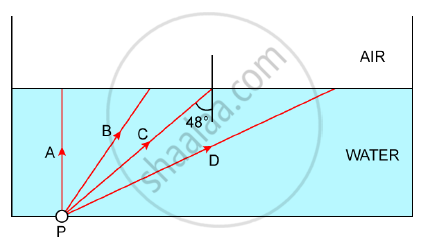
- Show in the diagram the path of these rays after striking the water surface. The Critical Angle for the water-air surface is 48°.
- Name the phenomenon which the rays B and D exhibit.
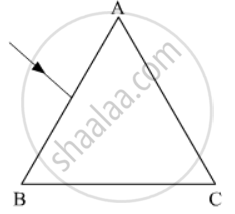
The figure shows a ray of light falling normally on the face AB of an equilateral glass prism having refractive index`3/2`, placed in water of refractive index `4/3`.Will this ray suffer total internal reflection on striking the face AC? Justify your answer.
Draw the diagram of a right-angled isosceles prism which is used to make an invented image erect.
Angle of deviation is the angle which the ______ ray makes with the direction of ______ray.
Total internal reflection occurs only when a ray of light passes from a ______ medium to a ______ medium.
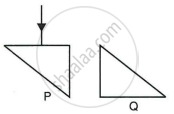
Two isosceles right-angle glass prisms P and Q are placed near each other as shown in Fig. Complete the path of the light ray entering the prism P till it emerges out of the prism Q.
Write the necessary conditions for the phenomenon of total internal reflection to
occur ?
One day Chetan’s mother developed a severe stomach ache all of a sudden. She was rushed to the doctor who suggested for an immediate endoscopy test and gave an estimate of expenditure for the same. Chetan immediately contacted his class teacher and shared the information with her. The class teacher arranged for the money and rushed to the hospital. On realizing that Chetan belonged to a below average income group family, even the doctor offered concession for the test fee. The test was conducted successfully.
Answer the following questions based on the above information:
(a) Which principle in optics is made use of in endoscopy?
(b) Briefly explain the values reflected in the action taken by the teacher.
(c) In what way do you appreciate the response of the doctor on the given situation?
Calculate the speed of light in a medium whose critical angle is 30° ?
(i) Define critical angle.
(ii) State one important factor which affects the critical angle of a given medium.
Plot a graph between
Angle of incidence versus angle of reflection,
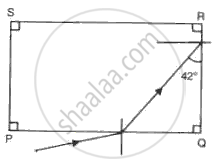
(a) A ray of monochromatic light enters glass PQRS as shown in the fig. Complete the path of ray till it emerges from the glass. (Critical angle of glass is 420).
(b) Draw diagram of a prism periscope.
(c) What are the advantages of total internal reflecting prism over plane mirror?
Write down the relationship between the critical angle and the refractive index of the medium.
Express the refractive index μ of a medium in terms of the angle of incidence i in air and the angle of refraction r in a denser medium.
State one factor on which a critical angle for a given pair of media depends. The critical angle for the glass-air interface is 45° for the yellow light. Will it be equal to, less than or greater than 45° for (i) red light, (ii) blue light?
Draw a diagram, properly labelled, to illustrate the use of a total reflecting prism (a right-angled isosceles prism) to turn a ray of light through 180°. Name an instrument in which this device is used.
The diagram shows a point source P inside a water container. Three rays A, B, and C starting from P are shown up to the water surface. Show in the diagram the path of these rays after striking the water surface. The critical angle for the water-air pair is 48°.

Answer the following question.
Under what conditions are total internal reflection possible? Explain it with a suitable example.
Answer the following question.
Define the critical angle of incidence and obtain an expression for it.
The resultant `vec"R"` of `vec"P"` and `vec"Q"` is perpendicular to `vec"P"`. Also `|vec"P"|=|vec"R"|`. The angle between `vec"P"` and `vec"Q"` is ______.
[tan 45° = 1]
Which one of the following is NOT the correct formula for refractive index of glass w.r.t. air (aμg) (i = angle of incidence, r = angle of refraction)
The twinkling effect of star light is due to ______.
The entire light is reflected back into the denser medium is called ______.
A green light is incident from the water to the air-water interface at the critical angle (θ). Select the correct statement.
A rectangular block of glass ABCD has a refractive index 1.6. A pin is placed midway on the face AB (Figure). When observed from the face AD, the pin shall ______.
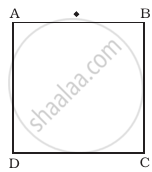
- appear to be near A.
- appear to be near D.
- appear to be at the centre of AD.
- not be seen at all.
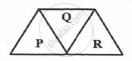
A given ray of light suffers minimum deviation in an equilateral prism P. Additional prism Q and R of identical shape and of the same material as P are now added as shown in the figure. The ray will now suffer ______.
State two differences between normal reflection and total internal reflection.
When a ray of light is refracted from one medium to another, then the wavelength changes from 6000 Å to 4000 Å. The critical angle for the interface will be ______.
