Advertisements
Advertisements
प्रश्न
PQ and PR are two light rays emerging from the object as shown in the figure below:

(i) What is the special name given to the angle of incidence (∠PQN) of ray PQ?
(ii) Copy the ray diagram and complete it to show the position of the image of the object P when seen obliquely from above.
(iii) Name the phenomenon that occurs if the angle of incidence ∠PQN is increased still further.
Advertisements
उत्तर
(i) Critical angle
(ii)

(iii) Total internal reflection of light.
संबंधित प्रश्न
State the conditions required for total internal reflection of light to take place.
Total internal reflection occurs only when a ray of light passes from a ______ medium to a ______ medium.
Total internal reflection can take place only if ______.
Define critical angle for a given medium.
Which of the following is not involved in formation of a rainbow?
For total internal reflection to take place, the angle of inddence i and the refractive index µ of the medium must satisfy the inequality ____________.
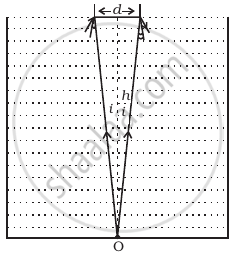
A jar of height h is filled with a transparent liquid of refractive index µ (Figure). At the centre of the jar on the bottom surface is a dot. Find the minimum diameter of a disc, such that when placed on the top surface symmetrically about the centre, the dot is invisible.
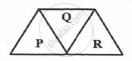
A given ray of light suffers minimum deviation in an equilateral prism P. Additional prism Q and R of identical shape and of the same material as P are now added as shown in the figure. The ray will now suffer ______.
The critical angle for water, which has a refractive index of 1.33, is:
The critical angle for crown glass, which has a refractive index of 1.52, is:
