Advertisements
Advertisements
प्रश्न
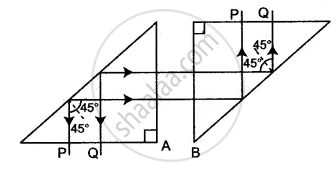
The adjacent diagram shows two right-angled isosceles prisms A and B. Complete the diagram to show the path of rays P and Q emerging out of the prism B. What principles have you used to complete the diagram?

Advertisements
उत्तर
The completed ray diagram is shown in the figure.
Following two principles are used to complete the diagram:
(1) A ray of light incident normally on the interface of two media passes undeviated.
(2) A ray of light striking the interface of two media (glass and air) from glass, at an angle of incidence, equal to 45° (which is greater than the critical angle = 42°) suffers total internal reflection.
APPEARS IN
संबंधित प्रश्न
Plot a graph between
Angle of incidence versus angle of reflection,
A ray of light incident at an angle of incidence ‘i’ passes through an equilateral glass prism such that the refracted ray inside the prism is parallel to its base and emerges from the prism at an angle of emergence ‘e’.
How is the angle of emergence ‘e’ related to the angle of incidence ‘i’?
State one factor on which a critical angle for a given pair of media depends. The critical angle for the glass-air interface is 45° for the yellow light. Will it be equal to, less than or greater than 45° for (i) red light, (ii) blue light?
How is the critical angle of a material related to its refractive index?
Solve Numerical example.
A monochromatic ray of light is incident at 37° on an equilateral prism of refractive index 3/2. Determine angle of emergence and angle of deviation. If angle of prism is adjustable, what should its value be for emergent rays to be just possible for the same angle of incidence?
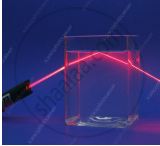
Observe the given figure and write appropriate phenomenon of light in the box.
For a ray of light, the critical angle is minimum when it travels from ______.
What is the phenomenon used in optical fiber? Explain.
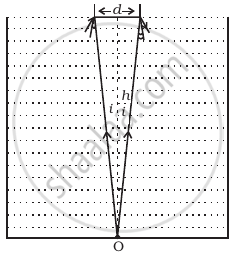
A jar of height h is filled with a transparent liquid of refractive index µ (Figure). At the centre of the jar on the bottom surface is a dot. Find the minimum diameter of a disc, such that when placed on the top surface symmetrically about the centre, the dot is invisible.
The angle made by incident ray of light with normal of the reflecting surface is called ______.
