Advertisements
Advertisements
Question
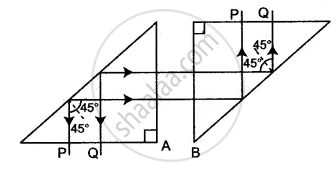
The adjacent diagram shows two right-angled isosceles prisms A and B. Complete the diagram to show the path of rays P and Q emerging out of the prism B. What principles have you used to complete the diagram?

Advertisements
Solution
The completed ray diagram is shown in the figure.
Following two principles are used to complete the diagram:
(1) A ray of light incident normally on the interface of two media passes undeviated.
(2) A ray of light striking the interface of two media (glass and air) from glass, at an angle of incidence, equal to 45° (which is greater than the critical angle = 42°) suffers total internal reflection.
APPEARS IN
RELATED QUESTIONS
You are given prisms made of crown glass and flint glass with a wide variety of angles. Suggest a combination of prisms which will
(a) deviate a pencil of white light without much dispersion,
(b) disperse (and displace) a pencil of white light without much deviation.
A ray of light travels from water to air as shown in the diagram given below :
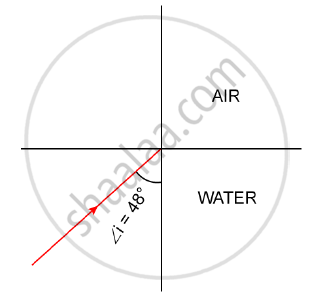
1) Copy the diagram and complete the path of the way. Given the critical angle for water is 48°.
2) State the condition so that internal reflection occurs in the above diagram.
Draw the diagram of a right-angled isosceles prism which is used to make an invented image erect.
The diagram shows a point source P inside a water container. Three rays A, B, and C starting from P are shown up to the water surface. Show in the diagram the path of these rays after striking the water surface. The critical angle for the water-air pair is 48°.

Complete the following diagram to show the path of the ray of a single colour in the diagram as if enters in and emerges out of the prism. Mark the angles wherever necessary. (Critical angle for glass = 42°).

For the same angle of incidence, the angle of refraction in four media A, B, C and D are 25°, 30°, 35° and 40° respectively. The speed of light is least in medium ______.
A light is entering from one medium refractive index `("RI" =5/3)` to another medium at an angle 30°. The angle of refraction for other medium is sin-1 `(5/6)`. then the increase in angle of incidence is ______ such that the ray of light reflected back into the same medium.
Small air bubbles rising up a fish tank appear silvery when viewed from some particular angle is due to the ______.
When a ray of light is refracted from one medium to another, then the wavelength changes from 6000 Å to 4000 Å. The critical angle for the interface will be ______.
