Advertisements
Advertisements
प्रश्न
Solve Numerical example.
A monochromatic ray of light is incident at 37° on an equilateral prism of refractive index 3/2. Determine angle of emergence and angle of deviation. If angle of prism is adjustable, what should its value be for emergent rays to be just possible for the same angle of incidence?
Advertisements
उत्तर
By Snell’s law, in case of prism,
n = `sin("i")/sin("r"_1)`
∴ `3/2=sin(37°)/sin("r"_1)`
∴ r1 = `sin^-1(0.6018/(3//2))`
= sin−1 (0.4012)
= 23°39’
For equilateral prism, A = 60°
Also, A= r1 + r2
∴ r2 = A − r1 = 60° – 23°39’ = 36°21’
Applying snell’s law on the second surface of prism,
`1/"n"=sin("r"_2)/sin("e")`
∴ `2/3=sin(36°21’)/sin("e")`
∴ e = `sin^-1((0.5927)/(2//3))`
= sin–1 (0.889)
= 62°44’
≈ 63
For any prism,
i + e = A + δ
∴ δ = (i + e) − A
= (37 + 63) − 60
= 40°
For an emergent ray to just emerge, the angle r2’ acts as a critical angle.
∴ r2’ = `sin^-1(1/"n")`
= `sin^-1(2/3)`
= 41’48°
As, A = r1 + r2 and i to be kept the same.
⇒ A’ = r1 + r2’ = 23°39’ + 41°48’
= 65°27’
- Angle of emergence and angle of deviation in first case are 63° and 40° respectively.
- For emergent ray to just emerge with same incident angle the angle of prism should have the value of 65°27’.
APPEARS IN
संबंधित प्रश्न
A light ray does not bend at the boundary in passing from one medium to the other medium if the angle of incident is ______.
What is total internal reflection?
State two conditions necessary for total internal reflection to occur.
Draw diagram to illustrate the total internal reflection.
Solve the previous problem if the paperweight is inverted at its place so that the spherical surface touches the paper.
The observation made by Swarali while doing the experiment is given below. Based on these write answers to the questions:
Swarali found that the light ray travelling from the denser medium to rarer medium goes away from the normal. If the angle of incidence (i) is raised by Swarali, the angle of refraction (r) went on increasing. However, after certain value of the angle of incidence the light ray is seen to return back into the denser medium.
Questions:
- What is the specific value of∠i called?
- What is the process of reflection of incident rays into denser medium called?
- Draw the diagrams of three observations made by Swarali.
(a) A ray of monochromatic light enters glass PQRS as shown in the fig. Complete the path of ray till it emerges from the glass. (Critical angle of glass is 420).
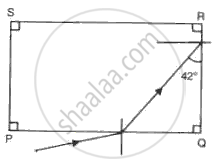
(b) Draw diagram of a prism periscope.
(c) What are the advantages of total internal reflecting prism over plane mirror?
Make the correct choices for each of the following :
Total Internal reflection takes place when
(where ∠i = angle of incidence, ∠r = angle of refraction, ∠C = critical angle)
In the following figure, show two rays A and B travelling from water to air. If the critical angle for water- air surface is 48°, complete the ray diagram showing the refracted rays for each. State conditions when the ray will suffer total internal reflection.
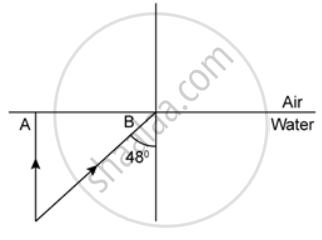
A ray of light incident at an angle of incidence ‘i’ passes through an equilateral glass prism such that the refracted ray inside the prism is parallel to its base and emerges from the prism at an angle of emergence ‘e’.
How is the angle of emergence ‘e’ related to the angle of incidence ‘i’?
What is meant by the statement, ‘the critical angle for diamond is 24°’?
The diagram shows a point source P inside a water container. Three rays A, B, and C starting from P are shown up to the water surface. Show in the diagram the path of these rays after striking the water surface. The critical angle for the water-air pair is 48°.

Complete the following diagram to show the path of the ray of a single colour in the diagram as if enters in and emerges out of the prism. Mark the angles wherever necessary. (Critical angle for glass = 42°).
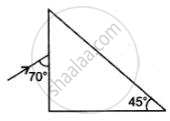
A ray of light is incident on a glass surface at an angle of 50° with the corresponding angle of refraction 30°. Find the value of the R.I. of glass.
Choose the correct option.
Consider the following phenomena/ applications: P) Mirage, Q) rainbow, R) Optical fibre and S) glittering of a diamond. Total internal reflection is involved in
Describe the construction and working of an optical fibre.
For the same angle of incidence, the angle of refraction in four media A, B, C and D are 25°, 30°, 35° and 40° respectively. The speed of light is least in medium ______.
For a ray of light, the critical angle is minimum when it travels from ______.
What is a mirage? How does it occur?
What are the examples of total internal reflection in nature?
The phenomena involved in the reflection of radiowaves by ionosphere is similar to ______.
Observe the given figure of the raindrop and answer the following questions:
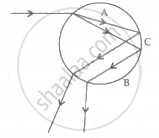
- Label A and B of the given diagram. Why colour will deviate most.
- Name the phenomenon shown in label C.
Which of the following is used in optical fibres?
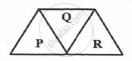
A given ray of light suffers minimum deviation in an equilateral prism P. Additional prism Q and R of identical shape and of the same material as P are now added as shown in the figure. The ray will now suffer ______.
- Assertion (A): Propagation of light through an optical fibre is due to total internal reflection taking place at the core-cladding interface.
- Reason (R): Refractive index of the material of the cladding of the optical fibre is greater than that of the core.
Total internal reflection is defined as the complete reflection of light back into an optically denser medium when:
When the angle of incidence for light going from a denser medium to a rarer medium is exactly equal to the critical angle, the result is:
When the angle of incidence for light travelling from a denser medium to a rarer medium is greater than the critical angle, the result is:
