Advertisements
Advertisements
Question
Solve Numerical example.
A monochromatic ray of light is incident at 37° on an equilateral prism of refractive index 3/2. Determine angle of emergence and angle of deviation. If angle of prism is adjustable, what should its value be for emergent rays to be just possible for the same angle of incidence?
Advertisements
Solution
By Snell’s law, in case of prism,
n = `sin("i")/sin("r"_1)`
∴ `3/2=sin(37°)/sin("r"_1)`
∴ r1 = `sin^-1(0.6018/(3//2))`
= sin−1 (0.4012)
= 23°39’
For equilateral prism, A = 60°
Also, A= r1 + r2
∴ r2 = A − r1 = 60° – 23°39’ = 36°21’
Applying snell’s law on the second surface of prism,
`1/"n"=sin("r"_2)/sin("e")`
∴ `2/3=sin(36°21’)/sin("e")`
∴ e = `sin^-1((0.5927)/(2//3))`
= sin–1 (0.889)
= 62°44’
≈ 63
For any prism,
i + e = A + δ
∴ δ = (i + e) − A
= (37 + 63) − 60
= 40°
For an emergent ray to just emerge, the angle r2’ acts as a critical angle.
∴ r2’ = `sin^-1(1/"n")`
= `sin^-1(2/3)`
= 41’48°
As, A = r1 + r2 and i to be kept the same.
⇒ A’ = r1 + r2’ = 23°39’ + 41°48’
= 65°27’
- Angle of emergence and angle of deviation in first case are 63° and 40° respectively.
- For emergent ray to just emerge with same incident angle the angle of prism should have the value of 65°27’.
APPEARS IN
RELATED QUESTIONS
A ray of light travels from water to air as shown in the diagram given below :
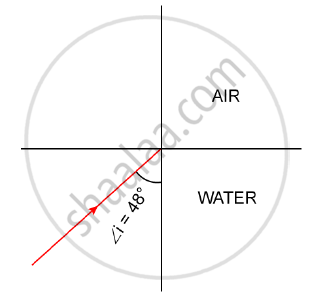
1) Copy the diagram and complete the path of the way. Given the critical angle for water is 48°.
2) State the condition so that internal reflection occurs in the above diagram.
What is total internal reflection?
Total internal reflection occurs only when a ray of light passes from a ______ medium to a ______ medium.
Two isosceles right-angle glass prisms P and Q are placed near each other as shown in Fig. Complete the path of the light ray entering the prism P till it emerges out of the prism Q.
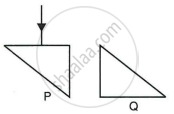
The observation made by Swarali while doing the experiment is given below. Based on these write answers to the questions:
Swarali found that the light ray travelling from the denser medium to rarer medium goes away from the normal. If the angle of incidence (i) is raised by Swarali, the angle of refraction (r) went on increasing. However, after certain value of the angle of incidence the light ray is seen to return back into the denser medium.
Questions:
- What is the specific value of∠i called?
- What is the process of reflection of incident rays into denser medium called?
- Draw the diagrams of three observations made by Swarali.
If a light ray does not undergo, refraction at the boundary between two media, the angle of incidence is:
How does a ray of light bend when it travels from when it is normal to the interface of the two media.
Can light be ‘piped’ like sound in a doctor’s stethoscope?
Write down the relationship between the critical angle and the refractive index of the medium.
State two advantages of using a right-angle prism as a reflector, rather than a plane mirror.
PQ and PR are two light rays emerging from the object as shown in the figure below:

(i) What is the special name given to the angle of incidence (∠PQN) of ray PQ?
(ii) Copy the ray diagram and complete it to show the position of the image of the object P when seen obliquely from above.
(iii) Name the phenomenon that occurs if the angle of incidence ∠PQN is increased still further.
Choose the correct option.
Angles of deviation for extreme colours are given for different prisms. Select the one having maximum dispersive power of its material.
Explain ‘mirage’ as an illustration of refraction.
Solve Numerical example.
From the given data set, determine angular dispersion by the prism and dispersive power of its material for extreme colours. nR = 1.62 nV = 1.66, δR = 3.1°
A green light is incident from the water to the air-water interface at the critical angle (C). Select the correct statement.
The angle of minimum deviation produced by a thin glass prism in air is 'δ'. If that prism is immersed in water, the angle of minimum deviation will be ______.
( aμg = refractive index of glass w.r.t, air aμw = refractive index of water w.r.t. air)
For a ray of light, the critical angle is minimum when it travels from ______.
Which of the following statements about total internal reflection is true?
What is the phenomenon used in optical fiber? Explain.
The phenomena involved in the reflection of radiowaves by ionosphere is similar to ______.
A rectangular block of glass ABCD has a refractive index 1.6. A pin is placed midway on the face AB (Figure). When observed from the face AD, the pin shall ______.
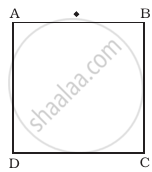
- appear to be near A.
- appear to be near D.
- appear to be at the centre of AD.
- not be seen at all.
A given ray of light suffers minimum deviation in an equilateral prism P. Additional prism Q and R of identical shape and of the same material as P are now added as shown in the figure. The ray will now suffer ______.
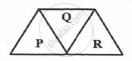
Small air bubbles rising up a fish tank appear silvery when viewed from some particular angle is due to the ______.
The critical angle is the angle of incidence in the denser medium for which the angle of refraction in the rarer medium is:
When the angle of incidence for light travelling from a denser medium to a rarer medium is greater than the critical angle, the result is:
