Advertisements
Advertisements
प्रश्न
Answer the following question.
Define the critical angle of incidence and obtain an expression for it.
Advertisements
उत्तर
- The critical angle for a pair of refracting media can be defined as that angle of incidence in the denser medium for which the angle of refraction in the rarer medium is 90°.
- Let n be the relative refractive index of a denser medium with respect to the rarer.
- Then, according to Snell’s law,
n = `"n"_"denser"/"n"_"rarer"=(sin"r")/(sin"i"_"c")=(sin90°)/(sin"i"_"c")`
∴ sin (ic) = `1/"n"`
APPEARS IN
संबंधित प्रश्न
State the relation between the critical angle and the absolute refractive index of a medium.
Angle of deviation is the angle which the ______ ray makes with the direction of ______ray.
Draw diagram to illustrate the total internal reflection.
Total internal reflection occurs only when a ray of light passes from a ______ medium to a ______ medium.
In the given figure PQ and PR are the two light rays emerging from an object P. The ray PQ is refracted as QS.

- State the special name given to the angle of incidence ∠PQN of the ray PQ.
- What is the angle of refraction for the refracted ray QS?
- Name the phenomenon that occurs if the angle of incidence ∠PQN is increased.
- The ray PR suffers partial reflection and refraction on the water-air surface. Give reason.
- Draw in the diagram the refracted ray for the incident ray PR and hence show the position of image of the object P by the letter P’ when seen vertically from above.
Write the necessary conditions for the phenomenon of total internal reflection to
occur ?
Write the relation between the refractive index and critical angle for a given pair of optical media?
Calculate the speed of light in a medium whose critical angle is 30° ?
Prove the statement.
A rainbow is the combined effect of the refraction, dispersion, and total internal reflection of light.
Swarali has got the following observations while doing an experiment. Answer her questions with the help of observations.
Swarali observed that the light bent away from the normal, while travelling from dense medium to rarer medium. When Swarali increased the values of angle of incidence (i), the values of angle of refraction (r) went on increasing. But at a certain angle of incidence, the light rays returned into the dense medium.
So, Swarali has some questions. Answer them –
a) Name this certain value of ‘i ’. What is the value of ‘r’ at that time ?
b) Name this process of returning of light in dense medium. Explain the process.
If a light ray does not undergo, refraction at the boundary between two media, the angle of incidence is:
How does a ray of light bend when it travels from rarer to denser medium
How does a ray of light bend when it travels from when it is normal to the interface of the two media.
Write down the relationship between the critical angle and the refractive index of the medium.
Express the refractive index μ of a medium in terms of the angle of incidence i in air and the angle of refraction r in a denser medium.
State two advantages of using a right-angle prism as a reflector, rather than a plane mirror.
What is meant by the term ‘critical angle’?
PQ and PR are two light rays emerging from the object as shown in the figure below:

(i) What is the special name given to the angle of incidence (∠PQN) of ray PQ?
(ii) Copy the ray diagram and complete it to show the position of the image of the object P when seen obliquely from above.
(iii) Name the phenomenon that occurs if the angle of incidence ∠PQN is increased still further.
Describe the construction and working of an optical fibre.
A green light is incident from the water to the air-water interface at the critical angle (C). Select the correct statement.
Optical fibre communication uses the principle of ______.
What is the phenomenon used in optical fiber? Explain.
State the condition under which total internal reflection occurs. Give the mathematical expression for total internal reflection.
Observe the given figure of the raindrop and answer the following questions:
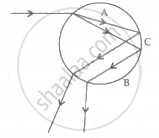
- Label A and B of the given diagram. Why colour will deviate most.
- Name the phenomenon shown in label C.
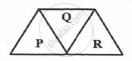
A given ray of light suffers minimum deviation in an equilateral prism P. Additional prism Q and R of identical shape and of the same material as P are now added as shown in the figure. The ray will now suffer ______.
Small air bubbles rising up a fish tank appear silvery when viewed from some particular angle is due to the ______.
The diagram below shows a fish in the tank and its image seen on the surface of the water.
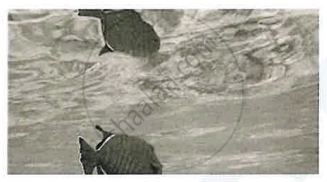
Name the phenomenon responsible for the formation of this image.
State two differences between normal reflection and total internal reflection.
The critical angle for water, which has a refractive index of 1.33, is:
