Advertisements
Advertisements
प्रश्न
Name two factors which affect the critical angle for a given pair of media. State how do the factors affect it.
Advertisements
उत्तर
The factors which affect the critical angle are:
- Wavelength (colour) of light: Since a transparent medium's refractive index increases with violet light and decreases with red light, the critical angle for a pair of media increases with red light and decreases with violet light. Thus, the critical angle rises as the light's wavelength increases.
- The temperature: The critical angle for that pair of media increases as the temperature of the medium rises because its refractive index falls. As a result, the critical angle rises as the temperature rises.
APPEARS IN
संबंधित प्रश्न
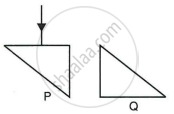
Two isosceles right-angle glass prisms P and Q are placed near each other as shown in Fig. Complete the path of the light ray entering the prism P till it emerges out of the prism Q.
Calculate the speed of light in a medium whose critical angle is 30° ?
(i) Define critical angle.
(ii) State one important factor which affects the critical angle of a given medium.
Why do diamonds sparkle?
What is meant by the term ‘critical angle’?
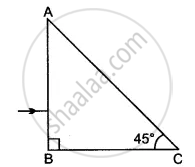
A ray of light passes through a right-angled prism as shown in the figure. State the angles of incidence at the faces AC and BC.
Optical fibre communication uses the principle of ______.
The entire light is reflected back into the denser medium is called ______.
When the angle of incidence for light travelling from a denser medium to a rarer medium is greater than the critical angle, the result is:
The formation of a mirage is explained using:
