Advertisements
Advertisements
प्रश्न
What do you understand by the deviation produced by a prism? Why is it caused?
Advertisements
उत्तर
Prism-produced Deviation is the bending of a light beam away from its intended path. Ray AB would have followed the path if there had been no prism. ABDF, but the prism has forced the light ray to bend twice in the direction of the prism's base, and the emerging beam EK seems to be coming from DEK.
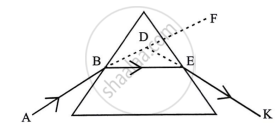
Cause: When light travels from one medium to another, in this example, from air to a glass prism, its speed changes. This change in speed causes the light to deflect and enter the new medium glass at a different angle.
APPEARS IN
संबंधित प्रश्न
How does a ray of light bend when it travels from denser to rarer medium.
How does a ray of light bend when it travels from when it is normal to the interface of the two media.
What is meant by the term ‘critical angle’?
The adjacent diagram shows two right-angled isosceles prisms A and B. Complete the diagram to show the path of rays P and Q emerging out of the prism B. What principles have you used to complete the diagram?

Answer the following question.
Under what conditions are total internal reflection possible? Explain it with a suitable example.
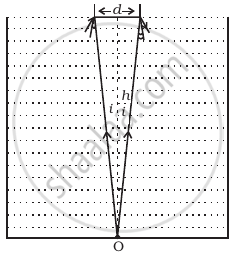
A jar of height h is filled with a transparent liquid of refractive index µ (Figure). At the centre of the jar on the bottom surface is a dot. Find the minimum diameter of a disc, such that when placed on the top surface symmetrically about the centre, the dot is invisible.
The diagram below shows a fish in the tank and its image seen on the surface of the water.
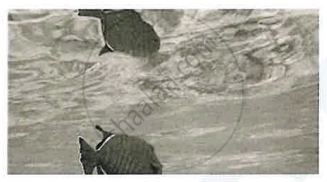
Name the phenomenon responsible for the formation of this image.
When a ray of light is refracted from one medium to another, then the wavelength changes from 6000 Å to 4000 Å. The critical angle for the interface will be ______.
