Advertisements
Advertisements
Question
Choose the correct option.
Consider the following phenomena/ applications: P) Mirage, Q) rainbow, R) Optical fibre and S) glittering of a diamond. Total internal reflection is involved in
Options
Only R and S
Only R
Only P, R and S
all the four
Advertisements
Solution
Only R and S
APPEARS IN
RELATED QUESTIONS
The diagram below shows a point source P inside a water container. Four rays A, B, C, D starting from the source P, are shown up to the water surface.
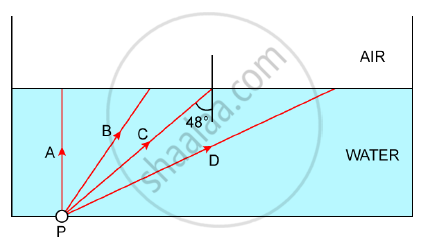
- Show in the diagram the path of these rays after striking the water surface. The Critical Angle for the water-air surface is 48°.
- Name the phenomenon which the rays B and D exhibit.
Which colour of light has a higher critical angle? Red light or green light.
Draw the diagram of a right-angled isosceles prism which is used to make an invented image erect.
A light ray does not bend at the boundary in passing from one medium to the other medium if the angle of incident is ______.
What is total internal reflection?
State two conditions necessary for total internal reflection to occur.
Write the relation between the refractive index and critical angle for a given pair of optical media?
Swarali has got the following observations while doing an experiment. Answer her questions with the help of observations.
Swarali observed that the light bent away from the normal, while travelling from dense medium to rarer medium. When Swarali increased the values of angle of incidence (i), the values of angle of refraction (r) went on increasing. But at a certain angle of incidence, the light rays returned into the dense medium.
So, Swarali has some questions. Answer them –
a) Name this certain value of ‘i ’. What is the value of ‘r’ at that time ?
b) Name this process of returning of light in dense medium. Explain the process.
Total internal reflection can take place only if ______.
Make the correct choices for each of the following :
Total Internal reflection takes place when
(where ∠i = angle of incidence, ∠r = angle of refraction, ∠C = critical angle)
How does a ray of light bend when it travels from when it is normal to the interface of the two media.
Why do diamonds sparkle?
Express the refractive index μ of a medium in terms of the angle of incidence i in air and the angle of refraction r in a denser medium.
A ray of light incident at an angle of incidence ‘i’ passes through an equilateral glass prism such that the refracted ray inside the prism is parallel to its base and emerges from the prism at an angle of emergence ‘e’.
How is the angle of emergence ‘e’ related to the angle of incidence ‘i’?
A ray of light incident at an angle of incidence ‘i’ passes through an equilateral glass prism such that the refracted ray inside the prism is parallel to its base and emerges from the prism at an angle of emergence ‘e’.
What can you say about the value of the angle of deviation in such a situation?
What is meant by the term ‘critical angle’?
A ray of light passes through a right-angled prism as shown in the figure. State the angles of incidence at the faces AC and BC.
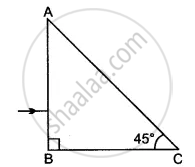
Complete the following diagram to show the path of the ray of a single colour in the diagram as if enters in and emerges out of the prism. Mark the angles wherever necessary. (Critical angle for glass = 42°).

Describe the construction and working of an optical fibre.
Solve Numerical example.
From the given data set, determine angular dispersion by the prism and dispersive power of its material for extreme colours. nR = 1.62 nV = 1.66, δR = 3.1°
Observe the given figure and write appropriate phenomenon of light in the box.
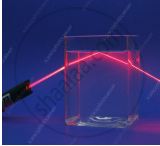
For total internal reflection to take place, the angle of inddence i and the refractive index µ of the medium must satisfy the inequality ____________.
Optical fibre communication uses the principle of ______.
Which of the following statements about total internal reflection is true?
A ray of light incident at an angle θ on a refracting face of a prism emerges from the other face normally. If the angle of the prism is 5° and the prism is made of a material of refractive index 1.5, the angle of incidence is ______.
Observe the given figure of the raindrop and answer the following questions:
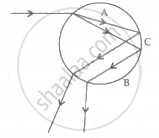
- Label A and B of the given diagram. Why colour will deviate most.
- Name the phenomenon shown in label C.
Name any two phenomena which take place in the formation of a rainbow.
State two differences between normal reflection and total internal reflection.
