Advertisements
Advertisements
Question
Name any two phenomena which take place in the formation of a rainbow.
Advertisements
Solution
The formation of a rainbow involves all three phenomena: Refraction, Dispersion and Total internal reflection.
APPEARS IN
RELATED QUESTIONS
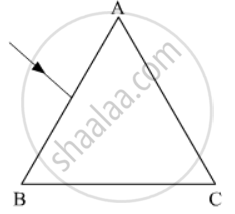
The figure shows a ray of light falling normally on the face AB of an equilateral glass prism having refractive index`3/2`, placed in water of refractive index `4/3`.Will this ray suffer total internal reflection on striking the face AC? Justify your answer.
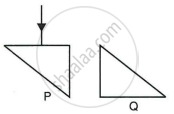
Two isosceles right-angle glass prisms P and Q are placed near each other as shown in Fig. Complete the path of the light ray entering the prism P till it emerges out of the prism Q.
Define critical angle for a given medium.
State two advantages of using a right-angle prism as a reflector, rather than a plane mirror.
Images formed by totally reflecting prisms are brighter than the image formed by ordinary reflected light, why?
A green light is incident from the water to the air-water interface at the critical angle (C). Select the correct statement.
For the same angle of incidence, the angle of refraction in four media A, B, C and D are 25°, 30°, 35° and 40° respectively. The speed of light is least in medium ______.
The critical angle is defined as the angle of incidence at which the total internal reflection starts to occur.
Write any two uses of total internal reflection.
The phenomena involved in the reflection of radiowaves by ionosphere is similar to ______.
