Advertisements
Advertisements
Questions
What is total internal reflection?
Explain total internal reflection of light.
Advertisements
Solution
Total internal reflection is the phenomenon when a ray of light travelling in a denser medium is incident at the surface of a rarer medium such that the angle of incidence is greater than the critical angle for the pair of media, and the ray is totally reflected back into the denser medium.
RELATED QUESTIONS
State two conditions necessary for total internal reflection to occur.
Solve the previous problem if the paperweight is inverted at its place so that the spherical surface touches the paper.
The diagram below shows a light source P embedded in a rectangular glass block ABCD of critical angle 42°. Complete the path of the ray PQ till it emerges out of the block. [Write necessary angles].

Plot a graph between
Angle of incidence versus angle of refraction.
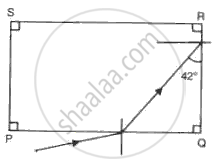
(a) A ray of monochromatic light enters glass PQRS as shown in the fig. Complete the path of ray till it emerges from the glass. (Critical angle of glass is 420).
(b) Draw diagram of a prism periscope.
(c) What are the advantages of total internal reflecting prism over plane mirror?
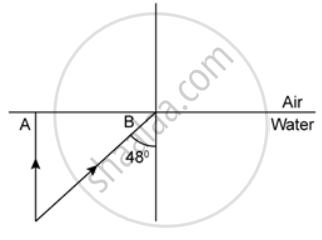
In the following figure, show two rays A and B travelling from water to air. If the critical angle for water- air surface is 48°, complete the ray diagram showing the refracted rays for each. State conditions when the ray will suffer total internal reflection.
How does a ray of light bend when it travels from denser to rarer medium.
If a ray of light passes from medium I to medium II without any change of direction, what can be said about the refractive indices of these media (angle I is not 0)?
The diagram shows a point source P inside a water container. Three rays A, B, and C starting from P are shown up to the water surface. Show in the diagram the path of these rays after striking the water surface. The critical angle for the water-air pair is 48°.

Choose the correct option.
Consider the following phenomena/ applications: P) Mirage, Q) rainbow, R) Optical fibre and S) glittering of a diamond. Total internal reflection is involved in
For the same angle of incidence, the angle of refraction in four media A, B, C and D are 25°, 30°, 35° and 40° respectively. The speed of light is least in medium ______.
Total internal reflection can take place only if light is travelling from ______.
A particle is projected such that the horizontal range and vertical height are equal. Then the angle of projection is :
The outer concentric shell in optic fiber is called ______.
What are the examples of total internal reflection in nature?
The phenomena involved in the reflection of radiowaves by ionosphere is similar to ______.
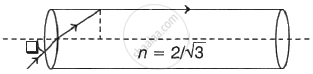
Find the value of θ in the given figure.
The diagram below shows a fish in the tank and its image seen on the surface of the water.
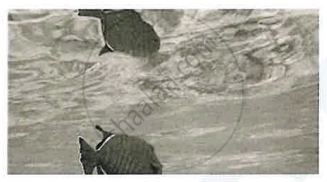
Name the phenomenon responsible for the formation of this image.
