Advertisements
Advertisements
Question
A ray of light is incident as a normal ray on the surface of separation of two different mediums. What is the value of the angle of incidence in this case?
Advertisements
Solution
Value of the angle of incidence, ∠i = 0°
RELATED QUESTIONS
State the relation between the critical angle and the absolute refractive index of a medium.
Write the relation between the refractive index and critical angle for a given pair of optical media?
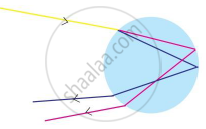
i) Observe the given figure and answer the following questions.
a) Identify and write the natural process shown in the figure.
b) List the phenomena which are observe in this process.
c) Redraw the diagram and show above phenomena in it.
The diagram below shows a light source P embedded in a rectangular glass block ABCD of critical angle 42°. Complete the path of the ray PQ till it emerges out of the block. [Write necessary angles].

Define critical angle for a given medium.
What is meant by the statement, ‘the critical angle for diamond is 24°’?
Answer the following question.
What are the advantages of optical fibre communication over electronic communication?
What are the examples of total internal reflection in nature?
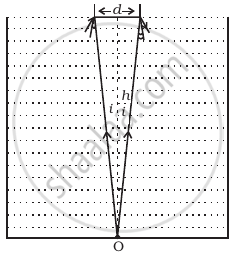
A jar of height h is filled with a transparent liquid of refractive index µ (Figure). At the centre of the jar on the bottom surface is a dot. Find the minimum diameter of a disc, such that when placed on the top surface symmetrically about the centre, the dot is invisible.
The critical angle for crown glass, which has a refractive index of 1.52, is:
