Advertisements
Advertisements
Question
State the relation between the critical angle and the absolute refractive index of a medium.
Advertisements
Solution
`mu = 1/(sin c)` or `sin c = 1/mu`where ‘c’ is the critical angle and ‘μ’ is the absolute refractive index.
APPEARS IN
RELATED QUESTIONS
If a light ray does not undergo, refraction at the boundary between two media, the angle of incidence is:
Name the factors affecting the critical angle for the pair of media.
Complete the following diagram to show the path of the ray of a single colour in the diagram as if enters in and emerges out of the prism. Mark the angles wherever necessary. (Critical angle for glass = 42°).

Solve Numerical example.
From the given data set, determine angular dispersion by the prism and dispersive power of its material for extreme colours. nR = 1.62 nV = 1.66, δR = 3.1°
Write any two uses of total internal reflection.
Observe the given figure of the raindrop and answer the following questions:
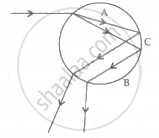
- Label A and B of the given diagram. Why colour will deviate most.
- Name the phenomenon shown in label C.
A ray of light passes from vacuum into a medium of refractive index µ, the angle of incidence is found to be twice the angle of refraction. Then the angle of incidence is ______.
The diagram below shows a fish in the tank and its image seen on the surface of the water.
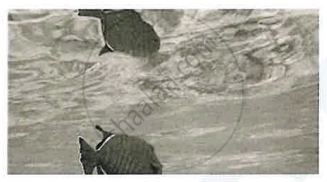
Name the phenomenon responsible for the formation of this image.
