Advertisements
Advertisements
Question
Choose the correct option.
Select the WRONG statement.
Options
Smaller angle of prism is recommended for greater angular dispersion.
Right-angled isosceles glass prism is commonly used for total internal reflection.
Angle of deviation is practically constant for thin prisms.
For emergent rays to be possible from the second refracting surface, certain minimum angle of incidence is necessary from the first surface.
Advertisements
Solution
Smaller angle of prism is recommended for greater angular dispersion.
APPEARS IN
RELATED QUESTIONS
You are given prisms made of crown glass and flint glass with a wide variety of angles. Suggest a combination of prisms which will
(a) deviate a pencil of white light without much dispersion,
(b) disperse (and displace) a pencil of white light without much deviation.
A ray of light travels from water to air as shown in the diagram given below :
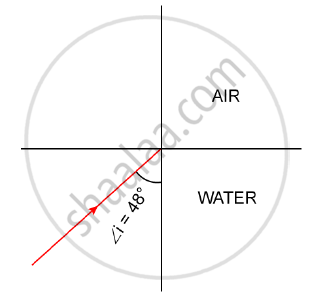
1) Copy the diagram and complete the path of the way. Given the critical angle for water is 48°.
2) State the condition so that internal reflection occurs in the above diagram.
The diagram below shows a point source P inside a water container. Four rays A, B, C, D starting from the source P, are shown up to the water surface.
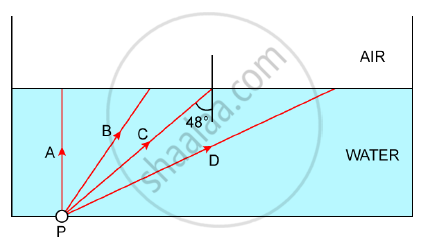
- Show in the diagram the path of these rays after striking the water surface. The Critical Angle for the water-air surface is 48°.
- Name the phenomenon which the rays B and D exhibit.
Draw the diagram of a right-angled isosceles prism which is used to make an invented image erect.
Angle of deviation is the angle which the ______ ray makes with the direction of ______ray.
The observation made by Swarali while doing the experiment is given below. Based on these write answers to the questions:
Swarali found that the light ray travelling from the denser medium to rarer medium goes away from the normal. If the angle of incidence (i) is raised by Swarali, the angle of refraction (r) went on increasing. However, after certain value of the angle of incidence the light ray is seen to return back into the denser medium.
Questions:
- What is the specific value of∠i called?
- What is the process of reflection of incident rays into denser medium called?
- Draw the diagrams of three observations made by Swarali.
Make the correct choices for each of the following :
Total Internal reflection takes place when
(where ∠i = angle of incidence, ∠r = angle of refraction, ∠C = critical angle)
Express the refractive index μ of a medium in terms of the angle of incidence i in air and the angle of refraction r in a denser medium.
If a ray of light passes from medium I to medium II without any change of direction, what can be said about the refractive indices of these media (angle I is not 0)?
How are critical angles related to the refractive index of the medium?
What is meant by the statement, ‘the critical angle for diamond is 24°’?
Which of the following is not involved in formation of a rainbow?
Answer the following question.
What are the advantages of optical fibre communication over electronic communication?
Solve Numerical example.
A monochromatic ray of light is incident at 37° on an equilateral prism of refractive index 3/2. Determine angle of emergence and angle of deviation. If angle of prism is adjustable, what should its value be for emergent rays to be just possible for the same angle of incidence?
Solve Numerical example.
From the given data set, determine angular dispersion by the prism and dispersive power of its material for extreme colours. nR = 1.62 nV = 1.66, δR = 3.1°
Total internal reflection can take place only if light is travelling from ______.
A bundle of glass threads, each of which is capable of transmitting messages using light waves is called ______.
Which of the following statements about total internal reflection is true?
What is a mirage? How does it occur?
The phenomena involved in the reflection of radiowaves by ionosphere is similar to ______.
Which of the following is used in optical fibres?
The diagram below shows a fish in the tank and its image seen on the surface of the water.
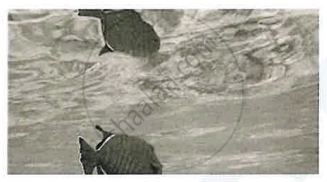
Name the phenomenon responsible for the formation of this image.
Total internal reflection is defined as the complete reflection of light back into an optically denser medium when:
If even one of the two required conditions for total internal reflection is missing, then:
When the angle of incidence for light going from a denser medium to a rarer medium is exactly equal to the critical angle, the result is:
