Advertisements
Advertisements
Question
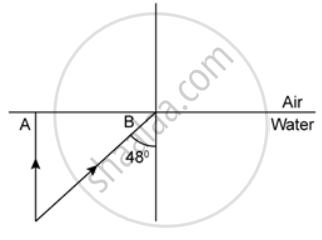
In the following figure, show two rays A and B travelling from water to air. If the critical angle for water- air surface is 48°, complete the ray diagram showing the refracted rays for each. State conditions when the ray will suffer total internal reflection.
Advertisements
Solution
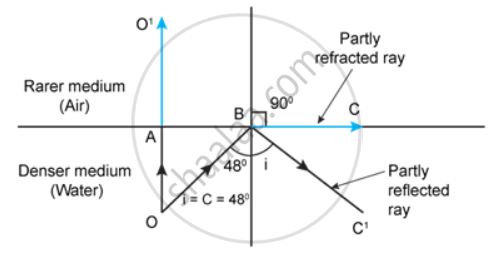
The necessary conditions for total internal reflection to occur are
- Light must travel from a denser medium to a rarer medium.
- The angle of incidence must be greater than the critical angle.
In this case, the angle of incidence. ∠ i > 48°
APPEARS IN
RELATED QUESTIONS
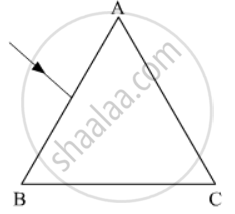
The figure shows a ray of light falling normally on the face AB of an equilateral glass prism having refractive index`3/2`, placed in water of refractive index `4/3`.Will this ray suffer total internal reflection on striking the face AC? Justify your answer.
Calculate the speed of light in a medium whose critical angle is 30° ?
If a light ray does not undergo, refraction at the boundary between two media, the angle of incidence is:
How does a ray of light bend when it travels from rarer to denser medium
How does a ray of light bend when it travels from denser to rarer medium.
A ray of light incident at an angle of incidence ‘i’ passes through an equilateral glass prism such that the refracted ray inside the prism is parallel to its base and emerges from the prism at an angle of emergence ‘e’.
How is the angle of emergence ‘e’ related to the angle of incidence ‘i’?
The diagram shows a point source P inside a water container. Three rays A, B, and C starting from P are shown up to the water surface. Show in the diagram the path of these rays after striking the water surface. The critical angle for the water-air pair is 48°.

Complete the following diagram to show the path of the ray of a single colour in the diagram as if enters in and emerges out of the prism. Mark the angles wherever necessary. (Critical angle for glass = 42°).
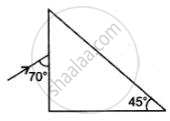
A ray of light passes through a prism of refractive index `sqrt2` as shown in the figure. Find:
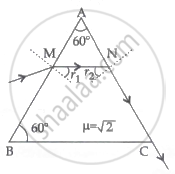
- The angle of incidence (∠r2) at face AC.
- The angle of minimum deviation for this prism.
