Advertisements
Advertisements
प्रश्न
Choose the correct option.
Select the WRONG statement.
पर्याय
Smaller angle of prism is recommended for greater angular dispersion.
Right-angled isosceles glass prism is commonly used for total internal reflection.
Angle of deviation is practically constant for thin prisms.
For emergent rays to be possible from the second refracting surface, certain minimum angle of incidence is necessary from the first surface.
Advertisements
उत्तर
Smaller angle of prism is recommended for greater angular dispersion.
APPEARS IN
संबंधित प्रश्न
A ray of light travels from water to air as shown in the diagram given below :
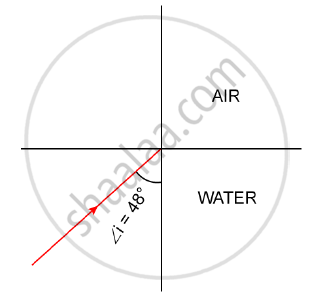
1) Copy the diagram and complete the path of the way. Given the critical angle for water is 48°.
2) State the condition so that internal reflection occurs in the above diagram.
Name the factors affecting the critical angle for the pair of media.
State the relation between the critical angle and the absolute refractive index of a medium.
Total internal reflection occurs only when a ray of light passes from a ______ medium to a ______ medium.
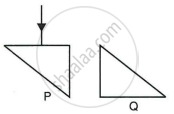
Two isosceles right-angle glass prisms P and Q are placed near each other as shown in Fig. Complete the path of the light ray entering the prism P till it emerges out of the prism Q.
One day Chetan’s mother developed a severe stomach ache all of a sudden. She was rushed to the doctor who suggested for an immediate endoscopy test and gave an estimate of expenditure for the same. Chetan immediately contacted his class teacher and shared the information with her. The class teacher arranged for the money and rushed to the hospital. On realizing that Chetan belonged to a below average income group family, even the doctor offered concession for the test fee. The test was conducted successfully.
Answer the following questions based on the above information:
(a) Which principle in optics is made use of in endoscopy?
(b) Briefly explain the values reflected in the action taken by the teacher.
(c) In what way do you appreciate the response of the doctor on the given situation?
Swarali has got the following observations while doing an experiment. Answer her questions with the help of observations.
Swarali observed that the light bent away from the normal, while travelling from dense medium to rarer medium. When Swarali increased the values of angle of incidence (i), the values of angle of refraction (r) went on increasing. But at a certain angle of incidence, the light rays returned into the dense medium.
So, Swarali has some questions. Answer them –
a) Name this certain value of ‘i ’. What is the value of ‘r’ at that time ?
b) Name this process of returning of light in dense medium. Explain the process.
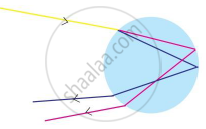
i) Observe the given figure and answer the following questions.
a) Identify and write the natural process shown in the figure.
b) List the phenomena which are observe in this process.
c) Redraw the diagram and show above phenomena in it.
The observation made by Swarali while doing the experiment is given below. Based on these write answers to the questions:
Swarali found that the light ray travelling from the denser medium to rarer medium goes away from the normal. If the angle of incidence (i) is raised by Swarali, the angle of refraction (r) went on increasing. However, after certain value of the angle of incidence the light ray is seen to return back into the denser medium.
Questions:
- What is the specific value of∠i called?
- What is the process of reflection of incident rays into denser medium called?
- Draw the diagrams of three observations made by Swarali.
Can light be ‘piped’ like sound in a doctor’s stethoscope?
If a ray of light passes from medium I to medium II without any change of direction, what can be said about the refractive indices of these media (angle I is not 0)?
How are critical angles related to the refractive index of the medium?
What is meant by the term ‘critical angle’?
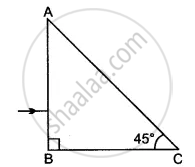
A ray of light passes through a right-angled prism as shown in the figure. State the angles of incidence at the faces AC and BC.
PQ and PR are two light rays emerging from the object as shown in the figure below:

(i) What is the special name given to the angle of incidence (∠PQN) of ray PQ?
(ii) Copy the ray diagram and complete it to show the position of the image of the object P when seen obliquely from above.
(iii) Name the phenomenon that occurs if the angle of incidence ∠PQN is increased still further.
Describe the construction and working of an optical fibre.
Answer the following question.
What are the advantages of optical fibre communication over electronic communication?
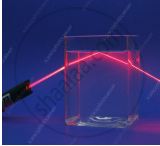
Observe the given figure and write appropriate phenomenon of light in the box.
Critical angle of light passing from glass to air is maximum for ____________.
For a ray of light, the critical angle is minimum when it travels from ______.
The critical angle is defined as the angle of incidence at which the total internal reflection starts to occur.
A rectangular block of glass ABCD has a refractive index 1.6. A pin is placed midway on the face AB (Figure). When observed from the face AD, the pin shall ______.
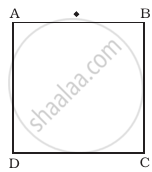
- appear to be near A.
- appear to be near D.
- appear to be at the centre of AD.
- not be seen at all.
A Rainbow is a beautiful natural phenomenon formed because of the following:
Observe the given figure of the raindrop and answer the following questions:
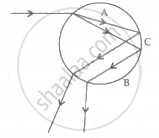
- Label A and B of the given diagram. Why colour will deviate most.
- Name the phenomenon shown in label C.
A light is entering from one medium refractive index `("RI" =5/3)` to another medium at an angle 30°. The angle of refraction for other medium is sin-1 `(5/6)`. then the increase in angle of incidence is ______ such that the ray of light reflected back into the same medium.
Which of the following is used in optical fibres?
The critical angle for water, which has a refractive index of 1.33, is:
