Advertisements
Advertisements
प्रश्न
A rectangular block of glass ABCD has a refractive index 1.6. A pin is placed midway on the face AB (Figure). When observed from the face AD, the pin shall ______.
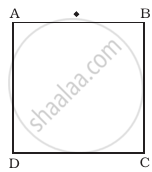
- appear to be near A.
- appear to be near D.
- appear to be at the centre of AD.
- not be seen at all.
पर्याय
a and c
a and d
b and d
c and d
Advertisements
उत्तर
a and d
Explanation:
As long as angle of incidence on AD of the ray emanating from the pin is less than the critical angle, the pin shall appear to be near A.

When angle of incidence on AD of the ray emanating from pins is greater than the critical angle, the light suffers from total internal reflection and cannot be seen through AD.
APPEARS IN
संबंधित प्रश्न
A ray of light travels from water to air as shown in the diagram given below :
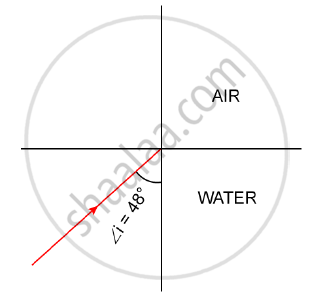
1) Copy the diagram and complete the path of the way. Given the critical angle for water is 48°.
2) State the condition so that internal reflection occurs in the above diagram.
What is total internal reflection?
Total internal reflection can take place only if ______.
(i) Define critical angle.
(ii) State one important factor which affects the critical angle of a given medium.
Make the correct choices for each of the following :
Total Internal reflection takes place when
(where ∠i = angle of incidence, ∠r = angle of refraction, ∠C = critical angle)
How does a ray of light bend when it travels from denser to rarer medium.
A ray of light incident at an angle of incidence ‘i’ passes through an equilateral glass prism such that the refracted ray inside the prism is parallel to its base and emerges from the prism at an angle of emergence ‘e’.
What can you say about the value of the angle of deviation in such a situation?
A ray of light passes through a right-angled prism as shown in the figure. State the angles of incidence at the faces AC and BC.
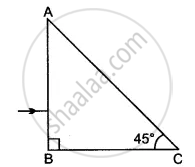
Complete the following diagram to show the path of the ray of a single colour in the diagram as if enters in and emerges out of the prism. Mark the angles wherever necessary. (Critical angle for glass = 42°).
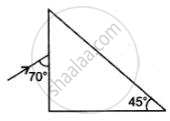
Answer the following question.
What are the advantages of optical fibre communication over electronic communication?
Critical angle of light passing from glass to air is maximum for ____________.
A Rainbow is a beautiful natural phenomenon formed because of the following:
A ray of light passes from vacuum into a medium of refractive index µ, the angle of incidence is found to be twice the angle of refraction. Then the angle of incidence is ______.
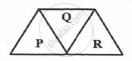
A given ray of light suffers minimum deviation in an equilateral prism P. Additional prism Q and R of identical shape and of the same material as P are now added as shown in the figure. The ray will now suffer ______.
The angle made by incident ray of light with normal of the reflecting surface is called ______.
Name any two phenomena which take place in the formation of a rainbow.
State two differences between normal reflection and total internal reflection.
When a ray of light is refracted from one medium to another, then the wavelength changes from 6000 Å to 4000 Å. The critical angle for the interface will be ______.
If even one of the two required conditions for total internal reflection is missing, then:
The critical angle for crown glass, which has a refractive index of 1.52, is:
