Advertisements
Advertisements
प्रश्न
(i) Define critical angle.
(ii) State one important factor which affects the critical angle of a given medium.
Advertisements
उत्तर
(i) The angle of incidence for which the angle of refraction is 90o is called critical angle.
`"_1 mu _2 = (sin i_c)/(sin (90^circ))`
`therefore (mu_2)/(mu_1) = (sini_c)/(1)`
` therefore 1/mu = sini_c " If " mu_2 = 1 mu_1 = mu`
` therefore i_c = sin^(-1) (1/mu)`
(ii) Relative refractive of the medium `("_1 mu_2)`1
APPEARS IN
संबंधित प्रश्न
Which colour of light has a higher critical angle? Red light or green light.
Draw the diagram of a right-angled isosceles prism which is used to make an invented image erect.
Total internal reflection occurs only when a ray of light passes from a ______ medium to a ______ medium.
Make the correct choices for each of the following :
Total Internal reflection takes place when
(where ∠i = angle of incidence, ∠r = angle of refraction, ∠C = critical angle)
Complete the following diagram to show the path of the ray of a single colour in the diagram as if enters in and emerges out of the prism. Mark the angles wherever necessary. (Critical angle for glass = 42°).
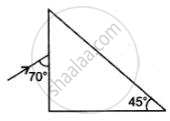
The angle of minimum deviation produced by a thin glass prism in air is 'δ'. If that prism is immersed in water, the angle of minimum deviation will be ______.
( aμg = refractive index of glass w.r.t, air aμw = refractive index of water w.r.t. air)
A particle is projected such that the horizontal range and vertical height are equal. Then the angle of projection is :
A green light is incident from the water to the air-water interface at the critical angle (θ). Select the correct statement.
Observe the given figure of the raindrop and answer the following questions:
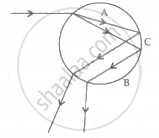
- Label A and B of the given diagram. Why colour will deviate most.
- Name the phenomenon shown in label C.
The critical angle for crown glass, which has a refractive index of 1.52, is:
