Advertisements
Advertisements
प्रश्न
Make the correct choices for each of the following :
Total Internal reflection takes place when
(where ∠i = angle of incidence, ∠r = angle of refraction, ∠C = critical angle)
पर्याय
Light is going from glass to air and ∠I < ∠C
Light is going from air to glss and ∠i < ∠C
Light is going from glass to air and ∠i > ∠C
Light is going from air to glss and ∠i > ∠C
Light is going from glass to air and ∠i = ∠r
Advertisements
उत्तर
Light is going from glass to air and ∠i > ∠C
APPEARS IN
संबंधित प्रश्न
State two conditions necessary for total internal reflection to occur.
Calculate the speed of light in a medium whose critical angle is 30° ?
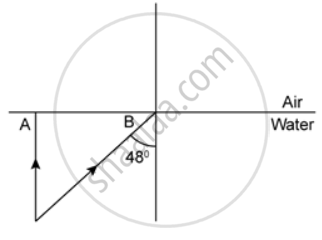
In the following figure, show two rays A and B travelling from water to air. If the critical angle for water- air surface is 48°, complete the ray diagram showing the refracted rays for each. State conditions when the ray will suffer total internal reflection.
How is the critical angle of a material related to its refractive index?
Draw a diagram, properly labelled, to illustrate the use of a total reflecting prism (a right-angled isosceles prism) to turn a ray of light through 180°. Name an instrument in which this device is used.
Critical angle of light passing from glass to air is maximum for ____________.
A light is entering from one medium refractive index `("RI" =5/3)` to another medium at an angle 30°. The angle of refraction for other medium is sin-1 `(5/6)`. then the increase in angle of incidence is ______ such that the ray of light reflected back into the same medium.
- Assertion (A): Propagation of light through an optical fibre is due to total internal reflection taking place at the core-cladding interface.
- Reason (R): Refractive index of the material of the cladding of the optical fibre is greater than that of the core.
If even one of the two required conditions for total internal reflection is missing, then:
The formation of a mirage is explained using:
