Advertisements
Advertisements
प्रश्न
Answer the following question.
Why is prism binoculars preferred over traditional binoculars? Describe its working in brief.
Advertisements
उत्तर
- Traditional binoculars use only two cylinders. Distance between the two cylinders can’t be greater than that between the two eyes. This creates a limitation of the field of view.
- A prism binocular has two right-angled glass prisms that apply the principle of total internal reflection.
- The incident light rays are reflected internally twice giving the viewer a wider field of view. For this reason, prism binoculars are preferred over traditional binoculars.
Working:

Prism binoculars
- The prism binoculars consist of 4 isosceles, right-angled prisms of a material having a critical angle less than 45°.
- The prism binoculars have a wider input range compared to traditional binoculars.
- The light rays incident on the prism binoculars, first get total internally reflected by the isosceles, right-angled prisms 1 and 4.
- These reflected rays undergo another total internal reflection by prisms 2 and 3 to form the final image.
APPEARS IN
संबंधित प्रश्न
State the conditions required for total internal reflection of light to take place.
Name the factors affecting the critical angle for the pair of media.
State the relation between the critical angle and the absolute refractive index of a medium.
What is total internal reflection?
In the given figure PQ and PR are the two light rays emerging from an object P. The ray PQ is refracted as QS.

- State the special name given to the angle of incidence ∠PQN of the ray PQ.
- What is the angle of refraction for the refracted ray QS?
- Name the phenomenon that occurs if the angle of incidence ∠PQN is increased.
- The ray PR suffers partial reflection and refraction on the water-air surface. Give reason.
- Draw in the diagram the refracted ray for the incident ray PR and hence show the position of image of the object P by the letter P’ when seen vertically from above.
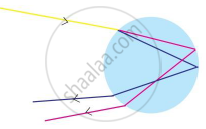
i) Observe the given figure and answer the following questions.
a) Identify and write the natural process shown in the figure.
b) List the phenomena which are observe in this process.
c) Redraw the diagram and show above phenomena in it.
Write down the relationship between the critical angle and the refractive index of the medium.
State two advantages of using a right-angle prism as a reflector, rather than a plane mirror.
What is meant by the term ‘critical angle’?
A ray of light passes through a right-angled prism as shown in the figure. State the angles of incidence at the faces AC and BC.
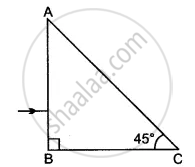
Complete the following diagram to show the path of the ray of a single colour in the diagram as if enters in and emerges out of the prism. Mark the angles wherever necessary. (Critical angle for glass = 42°).

PQ and PR are two light rays emerging from the object as shown in the figure below:

(i) What is the special name given to the angle of incidence (∠PQN) of ray PQ?
(ii) Copy the ray diagram and complete it to show the position of the image of the object P when seen obliquely from above.
(iii) Name the phenomenon that occurs if the angle of incidence ∠PQN is increased still further.
A spherical marble, of refractive index 1.5 and curvature 1.5 cm, contains a tiny air bubble at its centre. Where will it appear when seen from outside?
Choose the correct option.
Angles of deviation for extreme colours are given for different prisms. Select the one having maximum dispersive power of its material.
Which of the following is not involved in formation of a rainbow?
Explain ‘mirage’ as an illustration of refraction.
Answer the following question.
What are the advantages of optical fibre communication over electronic communication?
Solve Numerical example.
From the given data set, determine angular dispersion by the prism and dispersive power of its material for extreme colours. nR = 1.62 nV = 1.66, δR = 3.1°
Critical angle of light passing from glass to air is maximum for ____________.
For the same angle of incidence, the angle of refraction in four media A, B, C and D are 25°, 30°, 35° and 40° respectively. The speed of light is least in medium ______.
The angle of minimum deviation produced by a thin glass prism in air is 'δ'. If that prism is immersed in water, the angle of minimum deviation will be ______.
( aμg = refractive index of glass w.r.t, air aμw = refractive index of water w.r.t. air)
The outer concentric shell in optic fiber is called ______.
Write any two uses of total internal reflection.
What are the examples of total internal reflection in nature?
A Rainbow is a beautiful natural phenomenon formed because of the following:
- Assertion (A): Propagation of light through an optical fibre is due to total internal reflection taking place at the core-cladding interface.
- Reason (R): Refractive index of the material of the cladding of the optical fibre is greater than that of the core.
If even one of the two required conditions for total internal reflection is missing, then:
When the angle of incidence for light going from a denser medium to a rarer medium is exactly equal to the critical angle, the result is:
