Advertisements
Advertisements
प्रश्न
Solve Numerical example.
From the given data set, determine angular dispersion by the prism and dispersive power of its material for extreme colours. nR = 1.62 nV = 1.66, δR = 3.1°
Advertisements
उत्तर
Given: nR = 1.62, nV = 1.66, δR = 3.1°
To find: i. Angular dispersion (δVR)
ii. Dispersive power (ωVR)
Formula: i. δ = A (n − 1)
ii. δVR = δV − δR
iii. ω = `(δ_"V"-δ_"R")/(((δ_"V"+δ_"R")/2))`
Calculation: From formula (i),
δR = A(nR − 1)
∴ A = `δ_"R"/(("n"_"R"-1))=3.1/((1.62-1))=3.1/0.62`
∴ δV = A(nV − 1) = 5 × (1.66 − 1) = 3.3°
From formula (ii),
δVR = 3.3 − 3.1 = 0.2°
From formula (iii),
ωVR = `(3.3-3.1)/(((3.3+3.1)/2))=0.2/6.4xx2=0.2/3.2=1/16`
= 0.0625
- Angular dispersion by prism is 0.2°
- Dispersive power of material of prism is 0.0625.
APPEARS IN
संबंधित प्रश्न
What do you understand by the deviation produced by a prism? Why is it caused?
State two conditions necessary for total internal reflection to occur.
Total internal reflection occurs only when a ray of light passes from a ______ medium to a ______ medium.
Prove the statement.
A rainbow is the combined effect of the refraction, dispersion, and total internal reflection of light.
Total internal reflection can take place only if ______.
Plot a graph between
Sine of angle of incidence versus sine of angle of refraction,
Make the correct choices for each of the following :
Total Internal reflection takes place when
(where ∠i = angle of incidence, ∠r = angle of refraction, ∠C = critical angle)
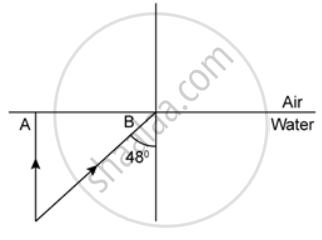
In the following figure, show two rays A and B travelling from water to air. If the critical angle for water- air surface is 48°, complete the ray diagram showing the refracted rays for each. State conditions when the ray will suffer total internal reflection.
A ray of light incident at an angle of incidence ‘i’ passes through an equilateral glass prism such that the refracted ray inside the prism is parallel to its base and emerges from the prism at an angle of emergence ‘e’.
How is the angle of emergence ‘e’ related to the angle of incidence ‘i’?
PQ and PR are two light rays emerging from the object as shown in the figure below:

(i) What is the special name given to the angle of incidence (∠PQN) of ray PQ?
(ii) Copy the ray diagram and complete it to show the position of the image of the object P when seen obliquely from above.
(iii) Name the phenomenon that occurs if the angle of incidence ∠PQN is increased still further.
Choose the correct option.
Select the WRONG statement.
Choose the correct option.
Angles of deviation for extreme colours are given for different prisms. Select the one having maximum dispersive power of its material.
Explain ‘mirage’ as an illustration of refraction.
Describe the construction and working of an optical fibre.
Critical angle of light passing from glass to air is maximum for ____________.
The angle of minimum deviation produced by a thin glass prism in air is 'δ'. If that prism is immersed in water, the angle of minimum deviation will be ______.
( aμg = refractive index of glass w.r.t, air aμw = refractive index of water w.r.t. air)
Total internal reflection can take place only if light is travelling from ______.
Which of the following statements about total internal reflection is true?
The critical angle is defined as the angle of incidence at which the total internal reflection starts to occur.
Write any two uses of total internal reflection.
The phenomena involved in the reflection of radiowaves by ionosphere is similar to ______.
A ray of light passes through a prism of refractive index `sqrt2` as shown in the figure. Find:
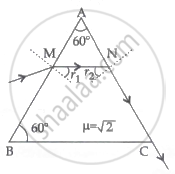
- The angle of incidence (∠r2) at face AC.
- The angle of minimum deviation for this prism.
- Assertion (A): Propagation of light through an optical fibre is due to total internal reflection taking place at the core-cladding interface.
- Reason (R): Refractive index of the material of the cladding of the optical fibre is greater than that of the core.
An endoscope uses optic fiber to transmit high resolution images of internal organs without loss of information. The principle of light that is used by the optic fiber is based on ______.
When the angle of incidence for light going from a denser medium to a rarer medium is exactly equal to the critical angle, the result is:
When the angle of incidence for light travelling from a denser medium to a rarer medium is greater than the critical angle, the result is:
