Advertisements
Advertisements
प्रश्न
Make the correct choices for each of the following :
Total Internal reflection takes place when
(where ∠i = angle of incidence, ∠r = angle of refraction, ∠C = critical angle)
विकल्प
Light is going from glass to air and ∠I < ∠C
Light is going from air to glss and ∠i < ∠C
Light is going from glass to air and ∠i > ∠C
Light is going from air to glss and ∠i > ∠C
Light is going from glass to air and ∠i = ∠r
Advertisements
उत्तर
Light is going from glass to air and ∠i > ∠C
APPEARS IN
संबंधित प्रश्न
Name the factors affecting the critical angle for the pair of media.
i) Observe the given figure and answer the following questions.
a) Identify and write the natural process shown in the figure.
b) List the phenomena which are observe in this process.
c) Redraw the diagram and show above phenomena in it.
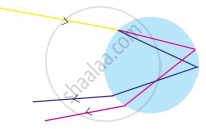
If a light ray does not undergo, refraction at the boundary between two media, the angle of incidence is:
If a ray of light passes from medium I to medium II without any change of direction, what can be said about the refractive indices of these media (angle I is not 0)?
State two advantages of using a right-angle prism as a reflector, rather than a plane mirror.
A ray of light incident at an angle of incidence ‘i’ passes through an equilateral glass prism such that the refracted ray inside the prism is parallel to its base and emerges from the prism at an angle of emergence ‘e’.
What can you say about the value of the angle of deviation in such a situation?
Solve Numerical example.
From the given data set, determine angular dispersion by the prism and dispersive power of its material for extreme colours. nR = 1.62 nV = 1.66, δR = 3.1°
Critical angle of light passing from glass to air is maximum for ____________.
The critical angle is defined as the angle of incidence at which the total internal reflection starts to occur.
Total internal reflection is defined as the complete reflection of light back into an optically denser medium when:
