Advertisements
Advertisements
प्रश्न
Make the correct for each of the following :
With reference to the fig, the refractive index of the glass block is
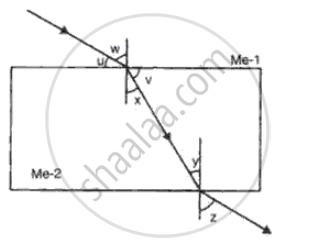
विकल्प
`"sin w"/"sin z"`
`"sin x"/"sin w"`
`"sin u"/"sin v"`
`"sin u"/"sin x"`
`"sin w"/"sin x"`
Advertisements
उत्तर
`"sin w"/"sin x"`
APPEARS IN
संबंधित प्रश्न
Write the relation between the angle of incidence and the angle of refraction for a medium.
How does the angle of minimum deviation produces by a prism change with increase in :
the wavelength of incident light
Fig shows a lens as a combination of a glass block and two prisms.
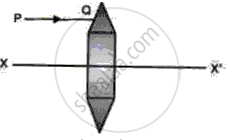
(i) Name the lens formed by the combination.
(ii) what is the XX' called?
(iii) Complete the ray diagram and show the path of the incident ray PQ after passing through the lens.
(iv) The final emergent ray will either meet XX' at a point or appear to come from a point on XX'. what is the point called?
Why does a fisherman aim at the tail of fish during spearfishing?
Which colour of light travels fastest in any medium except air?
State the relation between the refractive index μ and the velocity of light (vm) in that medium.
Draw the ray diagram of a glass slab having medium A and B for the velocity of light ray VA and VB respectively and define Snell's law.
- If VB = 1.5 VA, then which medium is denser?
- What is the refractive index of A with respect to B?
- What is the refractive index of B with respect to A?
