Advertisements
Advertisements
प्रश्न
Advertisements
उत्तर
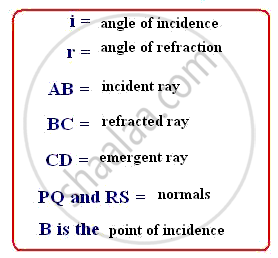
Refraction is the bending of light at the surface of separation, which takes when it passes from one optical medium to another optical medium with different optical densities.
Ray diagram showing refraction of light through a glass slab:

APPEARS IN
संबंधित प्रश्न
Explain how the formation of a rainbow occurs.
A monochromatic ray of light passes from air to glass. The wavelength of light in air is λ, the speed of light in air is c and in glass is V. If the absolute refractive index of glass is 1.5, write down
- the relationship between c and V,
- the wavelength of light in glass.
What do you understand by the statement the refractive index of glass is 1.5 for white light?
Name the phenomenon responsible in the following case:
Twinkling of stars
A fish swimming in a pond seems nearer than it really is. Explain.
During sunset and sunrise, the sun is seen when it is slightly below the horizon. Give reason.
Write a relation between the angle of incidence (i), angle of emergence (e), angle of the prism (A), and angle of deviation (d) for a ray of light passing through an equilateral prism.
In the diagram alongside a ray of light, PQ is incident normally on one face AB of an equilateral glass prism. What is the angle of incidence at the faces AB and AC?

The diagram shows the path of a ray of light through a rectangular glass block placed in a liquid of uniform density.

(a) Does the light speed up or slow down in the glass,
(b) Give the reason for your answer.
