Advertisements
Advertisements
प्रश्न
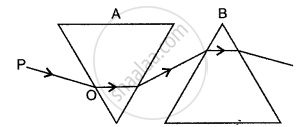
The figure shows two prisms A and B. A monochromatic ray of light PO is incident at the face of the prism A. Complete the diagram to show the path of the ray till it emerges out of the prism B.

Advertisements
उत्तर
संबंधित प्रश्न
Draw the diagram given below and clearly show the path taken by the emergent ray.
Draw diagrams to show the refraction of light from glass to air. In diagram, label the incident ray, refracted ray, the angle of incidence (i) and the angle of refraction (r).
How does the angle of minimum deviation produces by a prism change with increase in :
the wavelength of incident light
How does the speed of light change when it passes from glass to water?
Name the colour of white light which is deviated the most on passing through a prism.
Which colour of light travels fastest in any medium except air?
A fish swimming in a pond seems nearer than it really is. Explain.
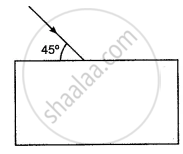
In the diagram below, PQ is a ray of light incident on a rectangular glass block.

Copy the diagram and complete the path of the ray of light through the glass block. In your diagram, mark the angle of incidence by letter ‘i’ and the angle of emergence by the letter ‘e’.
Trace a ray of light incident at 30° on a surface if travelling from air to glass. What is the angle of refraction in this case? (R.I. for glass = 3/2).
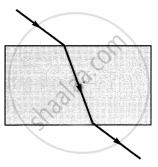
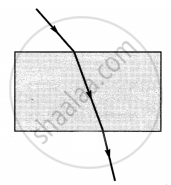
The path of a ray of light coming from air passing through a rectangular glass slab traced by four students are shown as A, B, C and D in the figure. Which one of them is correct?
 |
 |
 |
 |
| A | B | C | D |
