Advertisements
Advertisements
Question
Advertisements
Solution
Refraction is the bending of light at the surface of separation, which takes when it passes from one optical medium to another optical medium with different optical densities.
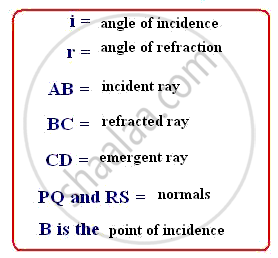
Ray diagram showing refraction of light through a glass slab:

APPEARS IN
RELATED QUESTIONS
Choose the correct alternative and rewrite the following sentence.
A ray of light strikes the glass slab at an angle of 50°. What is the angle of incidence?
A student very cautiously traces the path of a ray through a glass slab for different values of the angle of incidence (∠i). He then measures the corresponding values of the angle of refraction (∠r) and the angle of emergence (∠e) for every value of the angle of incidence. On analysing these measurements of angles, his conclusion would be
(A) ∠i > ∠r > ∠e
(B) ∠i = ∠e > ∠r
(C) ∠i < ∠r < ∠e
(D) ∠i = ∠e < ∠r
Write a relationship between the angle of incidence and angle of refractions for a given pair of media.
Light passes through a rectangular glass slab and through a triangular glass prism. In what way does the direction of the two emergent beams differ and why?
A ray of light passes from glass into air. The angle of refraction will be:
(a) equal to the angle of incidence
(b) greater than the angle of incidence
(c) smaller than the angle of incidence
(d) 45°
How must light travel out of a substance if it is not going to be refracted?
For which colour of white light, is the refractive index of a transparent medium the most?
How does the speed of light change when it passes from glass to water?
Which of the following is the best experimental set-up out of the four shown for tracing the path of a ray of light passing through a rectangular glass slab ?
“A ray of light incident on a rectangular glass slab immersed in any medium emerges parallel to itself.” Draw labelled ray diagram to justify the statement.
