Advertisements
Advertisements
प्रश्न
Write down the relationship between the critical angle and the refractive index of the medium.
Advertisements
उत्तर
Sin ic = `1/μ`
Where ic is the critical angle and μ is the refractive index of the medium.
संबंधित प्रश्न
A ray of light incident at an angle of incidence ‘i’ passes through an equilateral glass prism such that the refracted ray inside the prism is parallel to its base and emerges from the prism at an angle of emergence ‘e’.
What can you say about the value of the angle of deviation in such a situation?
Solve Numerical example.
A monochromatic ray of light is incident at 37° on an equilateral prism of refractive index 3/2. Determine angle of emergence and angle of deviation. If angle of prism is adjustable, what should its value be for emergent rays to be just possible for the same angle of incidence?
For a ray of light, the critical angle is minimum when it travels from ______.
The entire light is reflected back into the denser medium is called ______.
A bundle of glass threads, each of which is capable of transmitting messages using light waves is called ______.
Optical Fibres are based on the phenomenon of dispersion.
What is the phenomenon used in optical fiber? Explain.
A ray of light passes through a prism of refractive index `sqrt2` as shown in the figure. Find:
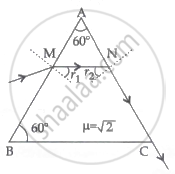
- The angle of incidence (∠r2) at face AC.
- The angle of minimum deviation for this prism.
Name any two phenomena which take place in the formation of a rainbow.
If even one of the two required conditions for total internal reflection is missing, then:
