Advertisements
Advertisements
प्रश्न
A rectangular block of glass ABCD has a refractive index 1.6. A pin is placed midway on the face AB (Figure). When observed from the face AD, the pin shall ______.
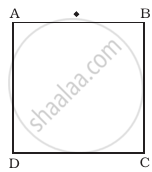
- appear to be near A.
- appear to be near D.
- appear to be at the centre of AD.
- not be seen at all.
विकल्प
a and c
a and d
b and d
c and d
Advertisements
उत्तर
a and d
Explanation:
As long as angle of incidence on AD of the ray emanating from the pin is less than the critical angle, the pin shall appear to be near A.

When angle of incidence on AD of the ray emanating from pins is greater than the critical angle, the light suffers from total internal reflection and cannot be seen through AD.
APPEARS IN
संबंधित प्रश्न
Name two factors which affect the critical angle for a given pair of media. State how do the factors affect it.
What is total internal reflection?
Write the necessary conditions for the phenomenon of total internal reflection to
occur ?
Define critical angle for a given medium.
Plot a graph between
Angle of incidence versus angle of reflection,
A ray of light incident at an angle of incidence ‘i’ passes through an equilateral glass prism such that the refracted ray inside the prism is parallel to its base and emerges from the prism at an angle of emergence ‘e’.
What can you say about the value of the angle of deviation in such a situation?
A ray of light passes through a right-angled prism as shown in the figure. State the angles of incidence at the faces AC and BC.
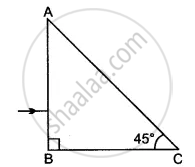
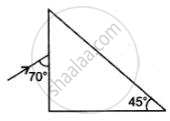
Complete the following diagram to show the path of the ray of a single colour in the diagram as if enters in and emerges out of the prism. Mark the angles wherever necessary. (Critical angle for glass = 42°).
A ray of light is incident as a normal ray on the surface of separation of two different mediums. What is the value of the angle of incidence in this case?
Choose the correct option.
Select the WRONG statement.
Which of the following is not involved in formation of a rainbow?
Answer the following question.
Under what conditions are total internal reflection possible? Explain it with a suitable example.
Answer the following question.
Define the critical angle of incidence and obtain an expression for it.
Observe the given figure and write appropriate phenomenon of light in the box.
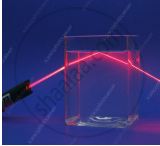
The critical angle is defined as the angle of incidence at which the total internal reflection starts to occur.
A ray of light incident at an angle θ on a refracting face of a prism emerges from the other face normally. If the angle of the prism is 5° and the prism is made of a material of refractive index 1.5, the angle of incidence is ______.
The phenomena involved in the reflection of radiowaves by ionosphere is similar to ______.
- Assertion (A): Propagation of light through an optical fibre is due to total internal reflection taking place at the core-cladding interface.
- Reason (R): Refractive index of the material of the cladding of the optical fibre is greater than that of the core.
If even one of the two required conditions for total internal reflection is missing, then:
