Advertisements
Advertisements
प्रश्न
State the relation between the critical angle and the absolute refractive index of a medium.
Advertisements
उत्तर
`mu = 1/(sin c)` or `sin c = 1/mu`where ‘c’ is the critical angle and ‘μ’ is the absolute refractive index.
APPEARS IN
संबंधित प्रश्न
What do you understand by the deviation produced by a prism? Why is it caused?
The diagram below shows a light source P embedded in a rectangular glass block ABCD of critical angle 42°. Complete the path of the ray PQ till it emerges out of the block. [Write necessary angles].

The adjacent diagram shows two right-angled isosceles prisms A and B. Complete the diagram to show the path of rays P and Q emerging out of the prism B. What principles have you used to complete the diagram?

Which of the following is not involved in formation of a rainbow?
The resultant `vec"R"` of `vec"P"` and `vec"Q"` is perpendicular to `vec"P"`. Also `|vec"P"|=|vec"R"|`. The angle between `vec"P"` and `vec"Q"` is ______.
[tan 45° = 1]
Write any two uses of total internal reflection.
A Rainbow is a beautiful natural phenomenon formed because of the following:
A ray of light passes through a prism of refractive index `sqrt2` as shown in the figure. Find:
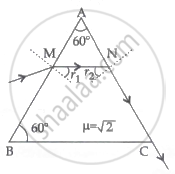
- The angle of incidence (∠r2) at face AC.
- The angle of minimum deviation for this prism.
Find the value of θ in the given figure.
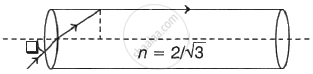
Total internal reflection is defined as the complete reflection of light back into an optically denser medium when:
