Advertisements
Advertisements
Question
The diagram below shows a point source P inside a water container. Four rays A, B, C, D starting from the source P, are shown up to the water surface.
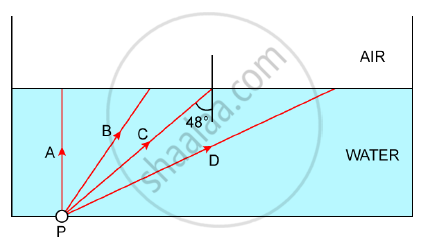
- Show in the diagram the path of these rays after striking the water surface. The Critical Angle for the water-air surface is 48°.
- Name the phenomenon which the rays B and D exhibit.
Advertisements
Solution
1)

2) Ray B shows the phenomenon of ‘refraction of light’ and ray D shows the phenomenon of ‘total internal reflection’.
APPEARS IN
RELATED QUESTIONS
You are given prisms made of crown glass and flint glass with a wide variety of angles. Suggest a combination of prisms which will
(a) deviate a pencil of white light without much dispersion,
(b) disperse (and displace) a pencil of white light without much deviation.
Draw diagram to illustrate the total internal reflection.
Write the necessary conditions for the phenomenon of total internal reflection to
occur ?
Choose the correct option.
Consider the following phenomena/ applications: P) Mirage, Q) rainbow, R) Optical fibre and S) glittering of a diamond. Total internal reflection is involved in
Explain ‘mirage’ as an illustration of refraction.
Solve Numerical example.
A monochromatic ray of light is incident at 37° on an equilateral prism of refractive index 3/2. Determine angle of emergence and angle of deviation. If angle of prism is adjustable, what should its value be for emergent rays to be just possible for the same angle of incidence?
Solve Numerical example.
From the given data set, determine angular dispersion by the prism and dispersive power of its material for extreme colours. nR = 1.62 nV = 1.66, δR = 3.1°
The twinkling effect of star light is due to ______.
Find the value of θ in the given figure.
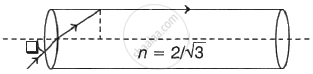
The critical angle is the angle of incidence in the denser medium for which the angle of refraction in the rarer medium is:
