Advertisements
Advertisements
प्रश्न
Choose the correct option.
Consider the following phenomena/ applications: P) Mirage, Q) rainbow, R) Optical fibre and S) glittering of a diamond. Total internal reflection is involved in
विकल्प
Only R and S
Only R
Only P, R and S
all the four
Advertisements
उत्तर
Only R and S
APPEARS IN
संबंधित प्रश्न
You are given prisms made of crown glass and flint glass with a wide variety of angles. Suggest a combination of prisms which will
(a) deviate a pencil of white light without much dispersion,
(b) disperse (and displace) a pencil of white light without much deviation.
State the conditions required for total internal reflection of light to take place.
A ray of light travels from water to air as shown in the diagram given below :
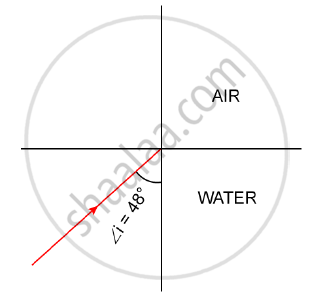
1) Copy the diagram and complete the path of the way. Given the critical angle for water is 48°.
2) State the condition so that internal reflection occurs in the above diagram.
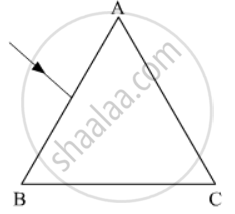
The figure shows a ray of light falling normally on the face AB of an equilateral glass prism having refractive index`3/2`, placed in water of refractive index `4/3`.Will this ray suffer total internal reflection on striking the face AC? Justify your answer.
Angle of deviation is the angle which the ______ ray makes with the direction of ______ray.
A light ray does not bend at the boundary in passing from one medium to the other medium if the angle of incident is ______.
Write the necessary conditions for the phenomenon of total internal reflection to
occur ?
Plot a graph between
Angle of incidence versus angle of reflection,
Plot a graph between
Sine of angle of incidence versus sine of angle of refraction,
Name the principle on the basis of which optical fibres work.
Express the refractive index μ of a medium in terms of the angle of incidence i in air and the angle of refraction r in a denser medium.
The diagram shows a point source P inside a water container. Three rays A, B, and C starting from P are shown up to the water surface. Show in the diagram the path of these rays after striking the water surface. The critical angle for the water-air pair is 48°.

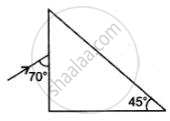
Complete the following diagram to show the path of the ray of a single colour in the diagram as if enters in and emerges out of the prism. Mark the angles wherever necessary. (Critical angle for glass = 42°).

Complete the following diagram to show the path of the ray of a single colour in the diagram as if enters in and emerges out of the prism. Mark the angles wherever necessary. (Critical angle for glass = 42°).
PQ and PR are two light rays emerging from the object as shown in the figure below:

(i) What is the special name given to the angle of incidence (∠PQN) of ray PQ?
(ii) Copy the ray diagram and complete it to show the position of the image of the object P when seen obliquely from above.
(iii) Name the phenomenon that occurs if the angle of incidence ∠PQN is increased still further.
A spherical marble, of refractive index 1.5 and curvature 1.5 cm, contains a tiny air bubble at its centre. Where will it appear when seen from outside?
Which of the following is not involved in formation of a rainbow?
The entire light is reflected back into the denser medium is called ______.
Which of the following statements about total internal reflection is true?
Optical Fibres are based on the phenomenon of dispersion.
The angle of incidence at which the angle of refraction is Q£ is called the critical angle.
What is the phenomenon used in optical fiber? Explain.
What are the examples of total internal reflection in nature?
The phenomena involved in the reflection of radiowaves by ionosphere is similar to ______.
A light is entering from one medium refractive index `("RI" =5/3)` to another medium at an angle 30°. The angle of refraction for other medium is sin-1 `(5/6)`. then the increase in angle of incidence is ______ such that the ray of light reflected back into the same medium.
Which of the following is used in optical fibres?
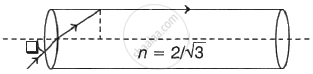
Find the value of θ in the given figure.
Name any two phenomena which take place in the formation of a rainbow.
When the angle of incidence for light going from a denser medium to a rarer medium is exactly equal to the critical angle, the result is:
