Advertisements
Advertisements
प्रश्न
A spherical marble, of refractive index 1.5 and curvature 1.5 cm, contains a tiny air bubble at its centre. Where will it appear when seen from outside?
विकल्प
1 cm inside
at the centre
`5/3` cm inside
2 cm inside
Advertisements
उत्तर
`bb(5/3)` cm inside
Explanation:
The refractive index of the marble is 1.5.
One can see the image formed due to the reflection in the spheres.
In order to determine the distance where the image will form, use the lens maker formula.
Hence, `mu_1/v - mu_2/u = (mu_2 - mu_1)/"R"`
Where, refractive index of air = 1, refractive index of glass = 1.5, Radius of the curvature = 1.5 cm
Substituting the values, we get,
`therefore 1/v - 1.5/0.75 = (1 - 1.5)/1.5`
`therefore 1/v - 2 = - 0.5/1.5`
`therefore 1/v - 2 = - 1/3`
`therefore 1/v = - 1/3 + 2`
`therefore 1/v = (- 1 + 6)/3`
`therefore 1/v = 5/3`
Therefore, the tiny bubble will be seen 5/3 cm inside when we see it from the outside.
APPEARS IN
संबंधित प्रश्न
Name two factors which affect the critical angle for a given pair of media. State how do the factors affect it.
One day Chetan’s mother developed a severe stomach ache all of a sudden. She was rushed to the doctor who suggested for an immediate endoscopy test and gave an estimate of expenditure for the same. Chetan immediately contacted his class teacher and shared the information with her. The class teacher arranged for the money and rushed to the hospital. On realizing that Chetan belonged to a below average income group family, even the doctor offered concession for the test fee. The test was conducted successfully.
Answer the following questions based on the above information:
(a) Which principle in optics is made use of in endoscopy?
(b) Briefly explain the values reflected in the action taken by the teacher.
(c) In what way do you appreciate the response of the doctor on the given situation?
Prove the statement.
A rainbow is the combined effect of the refraction, dispersion, and total internal reflection of light.
Solve the previous problem if the paperweight is inverted at its place so that the spherical surface touches the paper.
Define critical angle for a given medium.
Plot a graph between
Angle of incidence versus angle of refraction.
In the following figure, show two rays A and B travelling from water to air. If the critical angle for water- air surface is 48°, complete the ray diagram showing the refracted rays for each. State conditions when the ray will suffer total internal reflection.
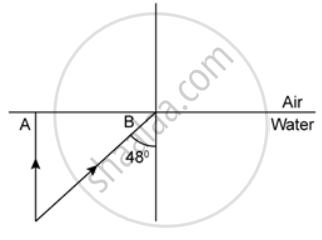
Write down the relationship between the critical angle and the refractive index of the medium.
Images formed by totally reflecting prisms are brighter than the image formed by ordinary reflected light, why?
A ray of light is incident as a normal ray on the surface of separation of two different mediums. What is the value of the angle of incidence in this case?
Choose the correct option.
Angles of deviation for extreme colours are given for different prisms. Select the one having maximum dispersive power of its material.
Explain ‘mirage’ as an illustration of refraction.
Answer the following question.
Under what conditions are total internal reflection possible? Explain it with a suitable example.
Answer the following question.
What are the advantages of optical fibre communication over electronic communication?
The resultant `vec"R"` of `vec"P"` and `vec"Q"` is perpendicular to `vec"P"`. Also `|vec"P"|=|vec"R"|`. The angle between `vec"P"` and `vec"Q"` is ______.
[tan 45° = 1]
For the same angle of incidence, the angle of refraction in four media A, B, C and D are 25°, 30°, 35° and 40° respectively. The speed of light is least in medium ______.
Which one of the following is NOT the correct formula for refractive index of glass w.r.t. air (aμg) (i = angle of incidence, r = angle of refraction)
Total internal reflection can take place only if light is travelling from ______.
Optical fibre communication uses the principle of ______.
A bundle of glass threads, each of which is capable of transmitting messages using light waves is called ______.
Optical Fibres are based on the phenomenon of dispersion.
What are the examples of total internal reflection in nature?
A green light is incident from the water to the air-water interface at the critical angle (θ). Select the correct statement.
A rectangular block of glass ABCD has a refractive index 1.6. A pin is placed midway on the face AB (Figure). When observed from the face AD, the pin shall ______.
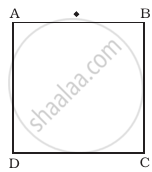
- appear to be near A.
- appear to be near D.
- appear to be at the centre of AD.
- not be seen at all.
State two differences between normal reflection and total internal reflection.
Total internal reflection is defined as the complete reflection of light back into an optically denser medium when:
The critical angle is the angle of incidence in the denser medium for which the angle of refraction in the rarer medium is:
