Advertisements
Advertisements
Question
Advertisements
Solution
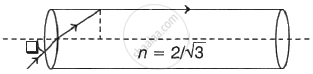
Critical angle: The angle of incidence in the denser medium for which the angle of refraction in the rarer medium is 90o.
Total internal reflection: It is an optical phenomenon that occurs when a ray of light strikes the boundary of denser medium at an angle greater than the critical angle w.r.t. the normal of the surface; this ray is then totally reflected back into the denser medium.
The two necessary conditions for total internal reflection to take place are:
1.The light ray must proceed from denser to rarer medium.
2. Angle of incidence in denser medium should be greater than the critical angle for the pair of media in contact.
APPEARS IN
RELATED QUESTIONS
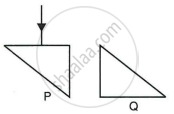
Two isosceles right-angle glass prisms P and Q are placed near each other as shown in Fig. Complete the path of the light ray entering the prism P till it emerges out of the prism Q.
Solve the previous problem if the paperweight is inverted at its place so that the spherical surface touches the paper.
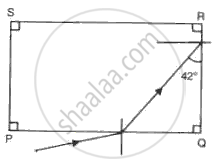
The diagram below shows a light source P embedded in a rectangular glass block ABCD of critical angle 42°. Complete the path of the ray PQ till it emerges out of the block. [Write necessary angles].

(a) A ray of monochromatic light enters glass PQRS as shown in the fig. Complete the path of ray till it emerges from the glass. (Critical angle of glass is 420).
(b) Draw diagram of a prism periscope.
(c) What are the advantages of total internal reflecting prism over plane mirror?
If a ray of light passes from medium I to medium II without any change of direction, what can be said about the refractive indices of these media (angle I is not 0)?
Choose the correct option.
Angles of deviation for extreme colours are given for different prisms. Select the one having maximum dispersive power of its material.
The resultant `vec"R"` of `vec"P"` and `vec"Q"` is perpendicular to `vec"P"`. Also `|vec"P"|=|vec"R"|`. The angle between `vec"P"` and `vec"Q"` is ______.
[tan 45° = 1]
The outer concentric shell in optic fiber is called ______.
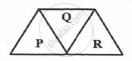
A given ray of light suffers minimum deviation in an equilateral prism P. Additional prism Q and R of identical shape and of the same material as P are now added as shown in the figure. The ray will now suffer ______.
Find the value of θ in the given figure.