Advertisements
Advertisements
Question
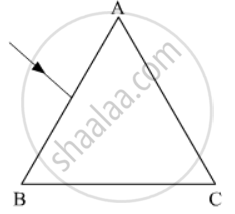
The figure shows a ray of light falling normally on the face AB of an equilateral glass prism having refractive index`3/2`, placed in water of refractive index `4/3`.Will this ray suffer total internal reflection on striking the face AC? Justify your answer.
Advertisements
Solution
For total internal reflection to happen at AC face, `sin theta >= mu_"water"/mu_"prism" = "4/3"/"3/2" = 8/9 = 0.89` where, θ is angle of incidence.
Now from the figure, we can see that angle of incidence will be 60 degrees.

So `sin 60 = sqrt3/2 = 0.866` which is less than 0.89
So total internal reflection will not take place at the face AC
APPEARS IN
RELATED QUESTIONS
Name two factors which affect the critical angle for a given pair of media. State how do the factors affect it.
Write the necessary conditions for the phenomenon of total internal reflection to
occur ?
How does a ray of light bend when it travels from rarer to denser medium
How is the critical angle of a material related to its refractive index?
The adjacent diagram shows two right-angled isosceles prisms A and B. Complete the diagram to show the path of rays P and Q emerging out of the prism B. What principles have you used to complete the diagram?

Write any two uses of total internal reflection.
What are the examples of total internal reflection in nature?
The angle made by incident ray of light with normal of the reflecting surface is called ______.
The critical angle for water, which has a refractive index of 1.33, is:
