Advertisements
Advertisements
Question
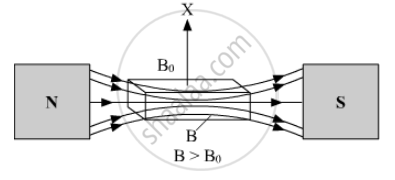
The susceptibility of a magnetic material is 0·9853. Identify the type of magnetic material. Draw the modification of the field pattern on keeping a piece of this material in a uniform magnetic field.
Advertisements
Solution
As we know that susceptibility of a paramagnetic substance is positive but small. Hence, the given magnetic material is paramagnetic in nature.
When a specimen of a paramagnetic substance is placed in a magnetising field, the magnetic field lines prefer to pass through the specimen rather than through air. Thus, magnetic induction B inside the sample is more than the magnetic induction B0 outside the sample.
APPEARS IN
RELATED QUESTIONS
Distinguish between ‘paramagnetic’ and ‘ferromagnetic’ substances.
Show diagrammatically the behaviour of magnetic field lines in the presence of (i) paramagnetic and (ii) diamagnetic substances. How does one explain this distinguishing feature?
Distinguish between diamagnetic and paramagnetic substances.
A tangent galvanometer shows a deflection of 45° when 10 mA of current is passed through it. If the horizontal component of the earth's magnetic field is `B_H = 3.6 xx 10^-5 "T"` and radius of the coil is 10 cm, find the number of turns in the coil.
A sphere of gold when brought towards a powerful magnet experiences ____________.
Most of the substance show which of the magnetic property:-
Which of the following cannot modify an external magnetic field as shown in the figure?

What is magnetic hysterisis?
Explain the Domain theory in brief.
What is the susceptibility of paramagnetic substances?
