Advertisements
Advertisements
Question
A short bar magnet has a magnetic moment of 0.48 J T−1. Give the direction and magnitude of the magnetic field produced by the magnet at a distance of 10 cm from the centre of the magnet on
- the axis,
- the equatorial lines (normal bisector) of the magnet.
Advertisements
Solution
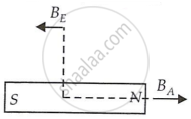
Given: Magnetic moment of the bar magnet, M = 0.48 J T−1
Distance, d = 10 cm = 0.1 m
(a) The magnetic field at a distance d from the centre of the magnet on the axis is given by the relation:
B = `μ_0/(4pi) (2M)/d^3`
Where,
μ0 = Permeability of free space = 4π × 10−7 T mA−1
∴ B = `(4pi xx 10^-7 xx 2 xx 0.48)/(4pi xx (0.1)^3)`
= 0.96 × 10⁻⁴ T
= 0.96 G
The magnetic field is along the S-N direction.
(b) The magnetic field at a distance of 10 cm (i.e., d = 0.1 m) on the equatorial line of the magnet is given as:
B = `(μ_0 xx M)/(4pi xx d^3)`
= `(4pi xx 10^-7 xx 0.48)/(4pi (0.1)^3)`
= 0.48 G
The magnetic field is along the N-S direction.
RELATED QUESTIONS
Distinguish between ‘paramagnetic’ and ‘ferromagnetic’ substances.
Identify the following magnetic materials :
Answer in brief.
Discuss the Curie law for paramagnetic material.
A domain in a ferromagnetic substance is in the form of a cube of side 1 µm. If it contains 8 × 10¹⁰ atoms and each atomic dipole has a dipole moment of 9 × 10-24 Am2 then the magnetisation of the domain is ______.
For a paramagnetic substance, the magnetic susceptibility is ______.
The magnetic susceptibility of a paramagnetic material at - 73 °C is 0.0075. Its value at -173 °C will be ______.
Is the permeability of a ferromagnetic material independent of the magnetic field? If not, is it more for lower or higher fields?
Magnetic field lines are always nearly normal to the surface of a ferromagnet at every point. (This fact is analogous to the static electric field lines being normal to the surface of a conductor at every point.) Why?
A certain region of space is to be shielded from magnetic fields. Suggest a method.
The magnetic susceptibility for diamagnetic materials is ______.
A permanent magnet in the shape of a thin cylinder of length 10 cm has M = 106 A/m. Calculate the magnetisation current IM.
A uniform magnetic field gets modified as shown in figure when two specimens A and B are placed in it.
 |
 |
| (a) | (b) |
- Identify the specimen A and B.
- How is the magnetic susceptibility of specimen A different from that of specimen B?
Which list contains only examples of diamagnetic substances?
Which list contains only examples of paramagnetic substances?
What happens to paramagnetic substances on cooling at the Curie temperature?
Which mathematical relation expresses Weiss Law for ferromagnetic substances above the Curie temperature?
How are the tiny domains oriented in an unmagnetised ferromagnetic specimen?
