Advertisements
Advertisements
Question
A rod of magnetic material of cross-section 0.25 cm2 is placed in a magnetizing field of intensity 4000 A/m-1. The magnetic flux passing through the rod is 25 × 10-6 Wb. Find out
(a) relative permeability
(b) magnetic susceptibility and
(c) magnetisation of the rod.
Advertisements
Solution
Given: A = 0.25 cm2 = 25 × 10-6 m2
H = 4000 A m-1, Φ = 25 × 10-6 Wb
Magnetic induction is
B = `phi/"A"`
`= (25 xx 10^-6)/(25 xx 10^-6)`
= 1 Wb/m2
(a) B = μ0μrH
∴ The relative permeability of the material,
`mu_"r" = "B"/(mu_0"H")`
`= 1/(4 xx 3.142 xx 10^-7 xx 4000)`
`= 10000/50.272`
= 198.91 = 199
(b) `mu_"r" = 1 + chi_"m"`
∴ The magnetic susceptibility of the material,
`chi_"m" = mu_"r" - 1`
= 199 - 1
= 198
(c) `chi_"m" = "M"_"z"/"H"`
The magnetization of the rod,
`"M"_"z" = chi_"m""H" = 198 xx 4000 = 7.92 xx 10^5`A/m
APPEARS IN
RELATED QUESTIONS
Distinguish between ‘paramagnetic’ and ‘ferromagnetic’ substances.
An iron rod of the area of cross-section 0.1m2 is subjected to a magnetizing field of 1000 A/m. Calculate the magnetic permeability of the iron rod. [Magnetic susceptibility of iron = 59.9, magnetic permeability of vacuum = 4π x 10-7 S. I. unit]
In what way is the behaviour of a diamagnetic material different from that of a paramagnetic, when kept in an external magnetic field?
Distinguish between diamagnetic and paramagnetic substances.
The susceptibility of a magnetic material is 0·9853. Identify the type of magnetic material. Draw the modification of the field pattern on keeping a piece of this material in a uniform magnetic field.
Which of the following substances are diamagnetic?
Bi, Al, Na, Cu, Ca and Ni
The susceptibility of a magnetic material is − 2.6 × 10⁻⁵. Identify the type of magnetic material and state its two properties.
The relative magnetic permeability of a magnetic material is 800. Identify the nature of magnetic material and state its two properties.
Draw magnetic field line when a (i) diamagnetic, (ii) paramagnetic substance is placed in an external magnetic field. Which magnetic property distinguishes this behaviour of the field line due to the substances?
Identify the following magnetic materials :
Which of the following statements is correct for diamagnetic materials?
Answer in brief.
Discuss the Curie law for paramagnetic material.
Two identical bar magnets each of magnetic moment M, separated by some distance are kept perpendicular to each other. The magnetic induction at a point at the same distance d from the centre of magnets, is (µ0 = permeability of free space)
Magnetic material can be easily magnetized if magnetic susceptibility is ______.
If a magnetic field is applied to a liquid in one arm of a narrow U-tube, the liquid level in that arm is lowered. The liquid in U-tube arm is ______.
The materials having negative magnetic susceptibility are ____________.
The magnetic property of magnetic substance is associated with ____________.
The product of magnetic susceptibility (`chi`) and absolute temperature (T) is constant for a ____________.
A small quantity of paramagnetic liquid is taken in a watch - glass and kept on two dissimilar magnetic poles. The liquid ____________.
The earth’s field departs from its dipole shape substantially at large distances (greater than about 30,000 km). What agencies may be responsible for this distortion?
A short bar magnet has a magnetic moment of 0.48 J T−1. Give the direction and magnitude of the magnetic field produced by the magnet at a distance of 10 cm from the centre of the magnet on
- the axis,
- the equatorial lines (normal bisector) of the magnet.
Which graph shows the variation of magnetic susceptibility (`chi`) with magnetizing field (H) for a paramagnetic substance?
Why does a paramagnetic sample display greater magnetisation (for the same magnetising field) when cooled?
What kind of ferromagnetic material is used for coating magnetic tapes in a cassette player, or for building ‘memory stores’ in a modern computer?
A Rowland ring of mean radius 15 cm has 3500 turns of wire wound on a ferromagnetic core of relative permeability 800. What is the magnetic field B in the core for a magnetising current of 1.2 A?
Nickel shows ferromagnetic property at room temperature. If the temperature is increased beyond curie temperature, then it will show ______.
The given figure represents a material which is ______.

Assertion: The ferromagnetic substance do not obey Curie’s law.
Reason: At Curie point a ferromagnetic substance start behaving as a paramagnetic substance.
Assertion: A paramagnetic sample display greater magnetisation (for the same magnetic field) when cooled.
Reason: The magnetisation does not depend on temperature.
Metals getting magnetised by orientation of atomic magnetic moments in external magnetic field are called ______.
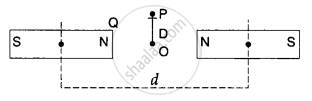
Two identical bar magnets are fixed with their centres at a distance d apart. A stationary charge Q is placed at P in between the gap of the two magnets at a distance D from the centre O as shown in the figure. The force on the charge Q is ______.
For a diamagnetic material
A permanent magnet in the shape of a thin cylinder of length 10 cm has M = 106 A/m. Calculate the magnetisation current IM.
From molecular view point, discuss the temperature dependence of susceptibility for diamagnetism, paramagnetism and ferromagnetism.
Which of the following has a permeability less than that of free space?
Which of the following cannot modify an external magnetic field as shown in the figure?

State the dimensions of magnetization.
Explain the meaning of the following statement:
Curie temperature for soft iron is 770°C.
Magnetic susceptibility of a diamagnetic substance ______.
Which substances are strongly magnetised in the direction of the magnetising field?
What is the susceptibility of paramagnetic substances?
How do paramagnetic substances respond to a magnetic field?
Which list contains only examples of diamagnetic substances?
Which list contains only examples of paramagnetic substances?
What happens to paramagnetic substances on cooling at the Curie temperature?
What happens to ferromagnetic substances on heating beyond the Curie temperature?
How are the tiny domains oriented in an unmagnetised ferromagnetic specimen?
