Advertisements
Advertisements
Question
Why does a paramagnetic sample display greater magnetisation (for the same magnetising field) when cooled?
Advertisements
Solution
Owing to the random thermal motion of the molecules, the alignments of dipoles get disrupted at high temperatures. On cooling, this disruption is reduced. Hence, a paramagnetic sample displays greater magnetisation when cooled.
APPEARS IN
RELATED QUESTIONS
In what way is the behaviour of a diamagnetic material different from that of a paramagnetic, when kept in an external magnetic field?
Two substances A and B have their relative permeability slightly greater and slightly less than 1 respectively. What do you conclude about A and B as far as their magnetic materials are concerned?
Choose the correct option:
A rectangular magnet suspended freely has a period of oscillation equal to T. Now it is broken into two equal halves (each having half of the original length) and one piece is made to oscillate freely. Its period of oscillation is T′, the ratio of T′/T is ______.
What happens to a ferromagnetic material when its temperature increases above curie temperature?
A paramagnetic gas has 2.0 × 1026 atoms/m with atomic magnetic dipole moment of 1.5 × 10⁻²³ A m2 each. The gas is at 27°C.
- Find the maximum magnetization intensity of this sample.
- If the gas in this problem is kept in a uniform magnetic field of 3 T, is it possible to achieve saturation magnetization? Why?
For a paramagnetic substance, the magnetic susceptibility is ______.
The materials having negative magnetic susceptibility are ____________.
Is the permeability of a ferromagnetic material independent of the magnetic field? If not, is it more for lower or higher fields?
Which of the following property shows the property of ferromagnetic substances?
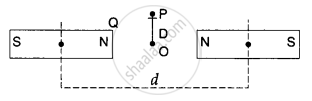
Two identical bar magnets are fixed with their centres at a distance d apart. A stationary charge Q is placed at P in between the gap of the two magnets at a distance D from the centre O as shown in the figure. The force on the charge Q is ______.
When a ferromagnetic material is created above its curie temperature
For a diamagnetic material
Most of the substance show which of the magnetic property:-
S is the surface of a lump of magnetic material.
- Lines of B are necessarily continuous across S.
- Some lines of B must be discontinuous across S.
- Lines of H are necessarily continuous across S.
- Lines of H cannot all be continuous across S.
Essential difference between electrostatic shielding by a conducting shell and magnetostatic shielding is due to ______.
- electrostatic field lines can end on charges and conductors have free charges.
- lines of B can also end but conductors cannot end them.
- lines of B cannot end on any material and perfect shielding is not possible.
- shells of high permeability materials can be used to divert lines of B from the interior region.
Magnetic susceptibility for a paramagnetic and diamagnetic materials is respectively ______.
Which of the following has a permeability less than that of free space?
The relative magnetic permeability of a substance X is slightly less than unity and that of substance Y is slightly more than unity, then ______.
How do diamagnetic substances respond to a magnetic field?
What causes the magnetic behaviour of ferromagnetic substances?
