Advertisements
Advertisements
Question
A paramagnetic gas has 2.0 × 1026 atoms/m with atomic magnetic dipole moment of 1.5 × 10⁻²³ A m2 each. The gas is at 27°C.
- Find the maximum magnetization intensity of this sample.
- If the gas in this problem is kept in a uniform magnetic field of 3 T, is it possible to achieve saturation magnetization? Why?
Advertisements
Solution
Data: `"N"/"V" = 2.0 xx 10^26` atoms/m3,
µ = 1.5 × 10⁻²³ Am2, T = 27 + 273 = 300 K, B = 3 T, kB = 1.38 × 10⁻²³ J/K, 1 eV = 1.6 × 10⁻¹⁹ J
(a) The maximum magnetization of the material,
`"M"_"z" = "N"/"V" mu = (2.0 xx 10^26)(1.5 xx 10^-23)`
= 3 × 10³ A/m
(b) The maximum orientation energy per atom is
`upsilon_"max" = - mu"B" cos 180^circ = mu"B"`
`= (1.5 xx 10^-23)(3) = (4.5 xx 10^-23)/(1.6 xx 10^-19)`
= 2.8 × 10⁻⁴ eV
The average thermal energy of each atom,
E = `3/2 "k"_"B" "T"`
where kB is the Botzmann constant.
∴ E = 1.5(1.38 × 10⁻²³)(300)
= 6.21 × 10⁻²¹ J = `(6.21 xx 10^-21)/(1.6 xx 10^-19)`
= 3.9 × 10⁻² eV
Since the thermal energy of randomization is about two orders of magnitude greater than the magnetic potential energy of orientation, saturation magnetization will not be achieved at 300 K.
APPEARS IN
RELATED QUESTIONS
Distinguish between ‘paramagnetic’ and ‘ferromagnetic’ substances.
Which of the following substances is ductile?
Give any ‘two’ points of differences between diamagnetic and ferromagnetic substances.
The susceptibility of magnesium at 200 K is 1.8 x 10⁻⁵. At what temperature will the susceptibility decrease by 6 x 10⁻⁶?
Which of the following substances are para-magnetic?
Bi, Al, Cu, Ca, Pb, Ni
The susceptibility of a magnetic material is − 2.6 × 10⁻⁵. Identify the type of magnetic material and state its two properties.
The relative magnetic permeability of a magnetic material is 800. Identify the nature of magnetic material and state its two properties.
Choose the correct option:
A magnetising field of 360 Am−1 produces a magnetic flux density (B) = 0.6T in a ferromagnetic material. What is its permeability in Tm A−1?
Answer in brief.
Discuss the Curie law for paramagnetic material.
The susceptibility of a paramagnetic material is χ at 27° C. At what temperature its susceptibility be χ/3?
The susceptibility of a magnetic material is positive and small. The material is ______.
All atoms of a magnetic substance have a resultant magnetic moment even in absence of external magnetic field. The substance is ______.
Relative permittivity and permeability of a material are `epsilon_"r"` and `µ_"r"` respectively. Which of the following values of these quantities are allowed for a diamagnetic material?
The materials having negative magnetic susceptibility are ____________.
Above the curie temperature the susceptibility of ferromagnetic substance varies ____________.
A domain in a ferromagnetic substance is in the form of a cube of side length 1 µm. If it contains 6 x 10¹⁰ atoms and each atomic dipole has a dipole moment of 7 x 10-24 Am2, then magnetization of the domain is ____________.
The earth’s field departs from its dipole shape substantially at large distances (greater than about 30,000 km). What agencies may be responsible for this distortion?
Why is diamagnetism, in contrast, almost independent of temperature?
If a toroid uses bismuth for its core, will the field in the core be (slightly) greater or (slightly) less than when the core is empty?
Explain qualitatively on the basis of domain picture the irreversibility in the magnetisation curve of a ferromagnet.
The coercivity of a small magnet where the ferromagnet gets demagnetized is 3 × 10³ Am–1. The current required to be passed in a solenoid of length 10 cm and number of turns 100, so that the magnet gets demagnetized when inside the solenoid, is ______.
The magnetic susceptibility is negative for ______.
Metals getting magnetised by orientation of atomic magnetic moments in external magnetic field are called ______.
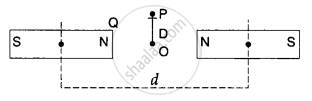
Two identical bar magnets are fixed with their centres at a distance d apart. A stationary charge Q is placed at P in between the gap of the two magnets at a distance D from the centre O as shown in the figure. The force on the charge Q is ______.
Earth's magnetic field analyses has a horizontal component except at:-
A hydrogen atom is paramagnetic. A hydrogen molecule is
For a diamagnetic material
If a charged particle at rest experience no electromagnetic force
S is the surface of a lump of magnetic material.
- Lines of B are necessarily continuous across S.
- Some lines of B must be discontinuous across S.
- Lines of H are necessarily continuous across S.
- Lines of H cannot all be continuous across S.
A permanent magnet in the shape of a thin cylinder of length 10 cm has M = 106 A/m. Calculate the magnetisation current IM.
From molecular view point, discuss the temperature dependence of susceptibility for diamagnetism, paramagnetism and ferromagnetism.
- Assertion (A): Diamagnetic substances exhibit magnetism.
- Reason (R): Diamagnetic materials do not have a permanent magnetic dipole moment.
Which of the following has a permeability less than that of free space?
The relative magnetic permeability of a substance X is slightly less than unity and that of substance Y is slightly more than unity, then ______.
Explain ferromagnetism on the basis of the domain theory.
Explain the origin of paramagnetism on the basis of atomic structure.
State the dimensions of magnetization.
Explain the Domain theory in brief.
Explain the meaning of the following statement:
Curie temperature for soft iron is 770°C.
Match List-I with List-II.
| List-I (Material) | List-II (Susceptibility) | ||
| A. | Diamagnetic | I. | χ = 0 |
| B. | Ferromagnetic | II. | 0 > χ ≥ −1 |
| C. | Paramagnetic | III. | χ >> 1 |
| D. | Non-magnetic | IV. | 0 < χ < ε |
Choose the correct answer from the options given below:
Which substances are feebly magnetised in a direction opposite to that of the magnetising field?
How do diamagnetic substances respond to a magnetic field?
How do paramagnetic substances respond to a magnetic field?
How do ferromagnetic substances respond to a magnetic field?
What happens to paramagnetic substances on cooling at the Curie temperature?
What causes the magnetic behaviour of ferromagnetic substances?
In the small-arrows analogy for ferromagnets, when does the total effect become strong?
