Advertisements
Advertisements
Question
Why is diamagnetism, in contrast, almost independent of temperature?
Advertisements
Solution
Each molecule of the diamagnetic material is not a magnetic dipole in itself. Hence, the random thermal motion of the molecules of the diamagnetic material (which is related to the temperature) does not affect the diamagnetism of the material.
APPEARS IN
RELATED QUESTIONS
The susceptibility of magnesium at 200 K is 1.8 x 10⁻⁵. At what temperature will the susceptibility decrease by 6 x 10⁻⁶?
The relative magnetic permeability of a magnetic material is 800. Identify the nature of magnetic material and state its two properties.
Two substances A and B have their relative permeability slightly greater and slightly less than 1 respectively. What do you conclude about A and B as far as their magnetic materials are concerned?
Choose the correct option:
A magnetising field of 360 Am−1 produces a magnetic flux density (B) = 0.6T in a ferromagnetic material. What is its permeability in Tm A−1?
All atoms of a magnetic substance have a resultant magnetic moment even in absence of external magnetic field. The substance is ______.
Magnetic material can be easily magnetized if magnetic susceptibility is ______.
A domain in a ferromagnetic substance is in the form of a cube of side length 1 µm. If it contains 6 x 10¹⁰ atoms and each atomic dipole has a dipole moment of 7 x 10-24 Am2, then magnetization of the domain is ____________.
Why does a paramagnetic sample display greater magnetisation (for the same magnetising field) when cooled?
Explain qualitatively on the basis of domain picture the irreversibility in the magnetisation curve of a ferromagnet.
The given figure represents a material which is ______.

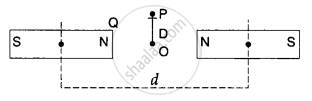
Two identical bar magnets are fixed with their centres at a distance d apart. A stationary charge Q is placed at P in between the gap of the two magnets at a distance D from the centre O as shown in the figure. The force on the charge Q is ______.
If a charged particle at rest experience no electromagnetic force
Magnetic susceptibility for a paramagnetic and diamagnetic materials is respectively ______.
- Assertion (A): Diamagnetic substances exhibit magnetism.
- Reason (R): Diamagnetic materials do not have a permanent magnetic dipole moment.
The relative magnetic permeability of a substance X is slightly less than unity and that of substance Y is slightly more than unity, then ______.
Which substances are feebly magnetised in a direction opposite to that of the magnetising field?
What is the susceptibility of paramagnetic substances?
Which list contains only examples of diamagnetic substances?
