Advertisements
Advertisements
Question
Explain quantitatively the order of magnitude difference between the diamagnetic susceptibility of N2 (~5 × 10⁻⁹) (at STP) and Cu (~10–5).
Advertisements
Solution
Magnetic susceptibility: It is the property of the substance which shows how easily a substance can be magnetised. It can also be defined as the ratio of intensity of magnetisation (I) in a substance to the magnetic intensity (H) applied to the substance, i.e., XM = I/H.
According to the problem, we have
Density of nitrogen `ρ_(N_2) = (28 g)/(22.4 L) = (28 g)/(22400 "cc")`
Also. density of copper `ρ_(C_u) = (8 g)/(22.4 L) = (8 g)/(22400 "cc")`
So, ratio of both densities
`(ρ_(N_2))/(ρ_(Cu)) = 28/22400 xx 1/8 = 16 xx 10^-4`
Also given `(chi_(N_2))/(chi_(Cu)) = (5 xx 10^-9)/10^-5 = 5 xx 10^-4`
`(chi_m)_("Fero") ≈ 10^3`
and `(chi_m)_("Para") ≈ 10^-5`
⇒ `((chi_m)_("Fero"))/((chi_m)_("Para")) = 10^3/10^-5 = 10^8`
APPEARS IN
RELATED QUESTIONS
In what way is the behaviour of a diamagnetic material different from that of a paramagnetic, when kept in an external magnetic field?
The relative magnetic permeability of a magnetic material is 800. Identify the nature of magnetic material and state its two properties.
Choose the correct option:
A rectangular magnet suspended freely has a period of oscillation equal to T. Now it is broken into two equal halves (each having half of the original length) and one piece is made to oscillate freely. Its period of oscillation is T′, the ratio of T′/T is ______.
Magnetic material can be easily magnetized if magnetic susceptibility is ______.
If a magnetic field is applied to a liquid in one arm of a narrow U-tube, the liquid level in that arm is lowered. The liquid in U-tube arm is ______.
There are three needles 'N1', 'N2' and 'N3' made of a ferromagnetic, a paramagnetic and a diamagnetic substance respectively. When a magnet is brought close to them, then it will ____________.
Why does a paramagnetic sample display greater magnetisation (for the same magnetising field) when cooled?
A Rowland ring of mean radius 15 cm has 3500 turns of wire wound on a ferromagnetic core of relative permeability 800. What is the magnetic field B in the core for a magnetising current of 1.2 A?
The magnetic susceptibility is negative for ______.
Which of the following property shows the property of ferromagnetic substances?
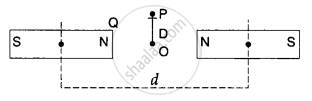
Two identical bar magnets are fixed with their centres at a distance d apart. A stationary charge Q is placed at P in between the gap of the two magnets at a distance D from the centre O as shown in the figure. The force on the charge Q is ______.
A long solenoid has 1000 turns per metre and carries a current of 1 A. It has a soft iron core of µr = 1000. The core is heated beyond the Curie temperature, Tc.
- The H field in the solenoid is (nearly) unchanged but the B field decreases drastically.
- The H and B fields in the solenoid are nearly unchanged.
- The magnetisation in the core reverses direction.
- The magnetisation in the core diminishes by a factor of about 108.
Magnetic susceptibility for a paramagnetic and diamagnetic materials is respectively ______.
Magnetic susceptibility of a diamagnetic substance ______.
Which substances are strongly magnetised in the direction of the magnetising field?
What is the susceptibility of diamagnetic substances?
What happens to paramagnetic substances on cooling at the Curie temperature?
How are the tiny domains oriented in an unmagnetised ferromagnetic specimen?
